For Buyers • For Home Owners • For Sellers • Kari's Blog • Real Estate Market Updates & Insight • May 11, 2023

May 2023 Real Estate Market Update

As the weather warms, so too does our real estate market, it seems. With dwindling inventory and climbing prices, the housing market is on an upswing, even if it’s a small one. This places sellers back in the driver’s seat, with buyers forced to compete against multiple offers and in the face of higher interest rates than last spring.

The evidence for the market’s positive growth can be found in higher median closed sales prices, an increased percentage of multiple offers, and a higher median percentage paid above the original asking price. At this point, the primary constraint on the market is a lower number of active listings. Many sellers are reluctant to part with their historically low-interest rates from the pandemic years, and with volatile interest rates, it’s an understandable predicament.

The lower number of available homes on the market has contributed to rising prices as buyers compete for a limited pool of properties. This trend often leads to multiple offers and bidding wars, further increasing prices.

For those buyers who do decide to jump into the fray, interest rates remain a key factor in determining their buying power. For the last few months, activity in the market has ticked up when rates dip, but some buyers are willing to face higher interest rates with the plan of refinancing when rates settle.

Even with that in mind, interest rates can have a huge impact on a buyer’s price bracket. For example, the median Seattle home price has declined by about 13% ($133,950) year-over-year. However, the increase in interest rates has offset this reduction. As a result, the median monthly mortgage payment remains around $5,507, which is comparable to the payment amount from a year ago — despite a lower median sold price.

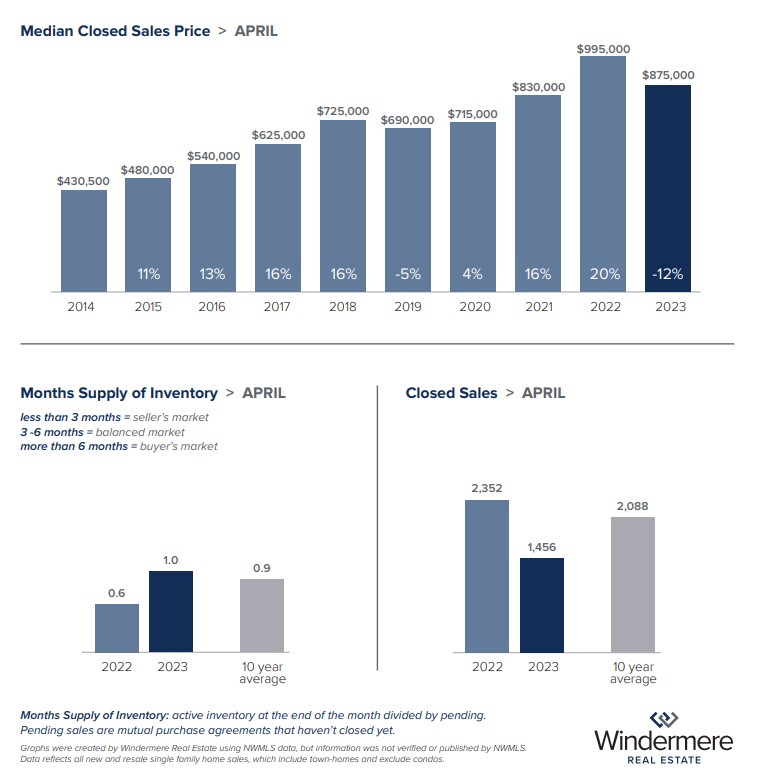
Although home prices in our region may be lower year-over-year, prices have generally been increasing each month this year. In King County, April’s median single-family home price was $875,000. That’s down 12.6% from last April’s $995,000 but up from a median of $840,000 in March. A single month of available inventory means competition for homes is tight throughout the county.

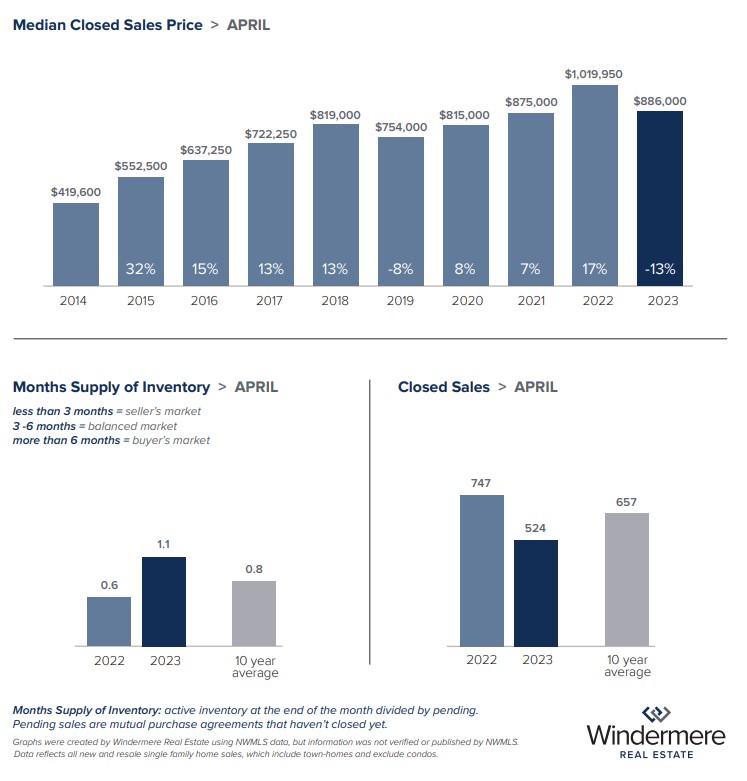
In Seattle, April’s median price for a single-family home was $886,000 — down quite a bit from the same month last year, when the median price was $1,019,950. However, prices were up from a median of $869,975 in March, and a low inventory of just over a month’s supply means demand is still high, and prices are likely to keep inching upward. Condo prices in the city were actually up year-over-year, with a median sold price of $539,000 in April, compared to $512,500 in April 2022.

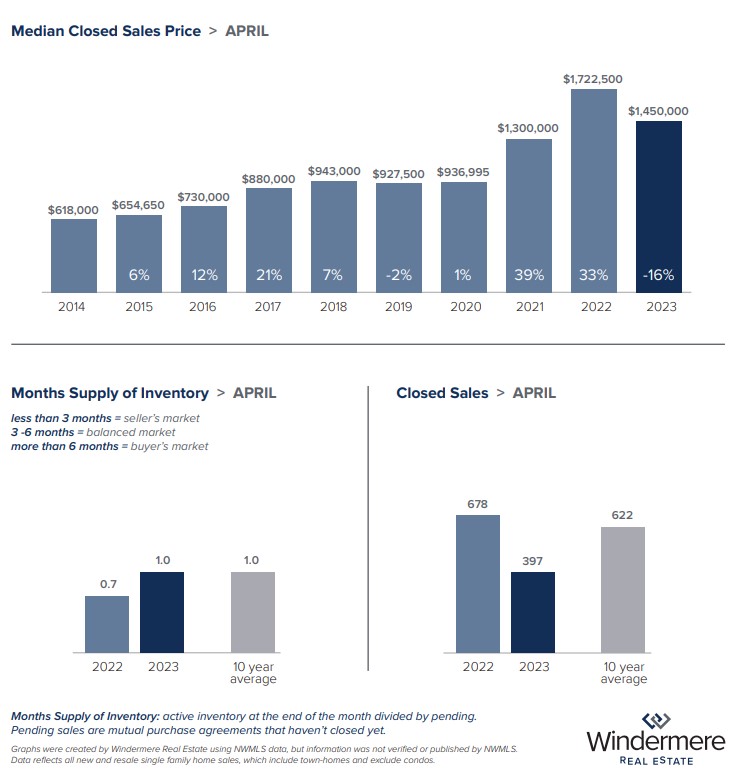
The Eastside also saw month-over-month price growth in April, with the median price for a single-family home landing at $1,450,000. This is up from $1,411,500 in March. Despite a 15% decrease in year-over-year prices, the current monthly price growth trend is notable. It’s likely we will not see the exponential price increases of the pandemic again anytime soon, making slow, steady growth the norm once again. The Eastside also has about one month of inventory for single-family homes, making it once again a competitive market.

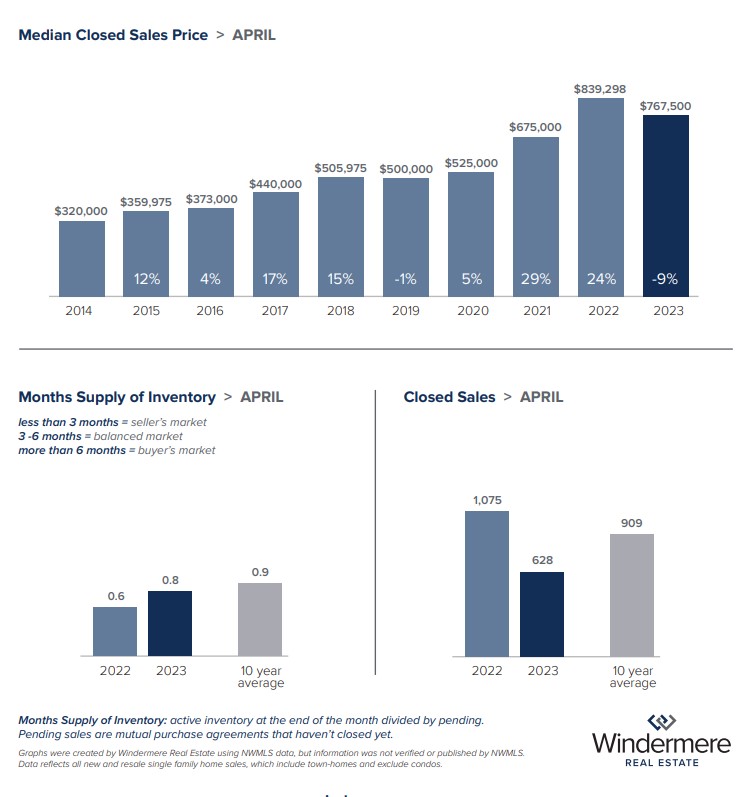
Finally, Snohomish County saw month-over-month price growth in April as well. The median price of a single-family home was $767,500, up from $724,000 in March. With less than one month of available inventory, the housing market in Snohomish County is trending warm-to-hot. Condos in the county had the tightest inventory of any market, with less than two weeks’ supply. That, combined with April’s median sold price of $544,900, makes the Snohomish County condo market a competitive market for buyers to break into.

If you have questions about these housing market trends or real estate in general, please reach out to Kari (206)719-2224


EASTSIDE
VIEW FULL EASTSIDE REPORT


KING COUNTY

VIEW FULL KING COUNTY REPORT


SEATTLE

VIEW FULL SEATTLE REPORT


SNOHOMISH COUNTY

VIEW FULL SNOHOMISH COUNTY REPORT


This post originally appeared on GetTheWReport.com.
For Sellers • Kari's Blog • Real Estate Related • May 11, 2023

How to Sell a Home After the Death of a Loved One

The loss of a loved one is a heartbreaking experience for everyone involved. But as an heir, along with grieving for your loss, there are other responsibilities you may have to dedicate your attention towards. One of these is handling the sale of the deceased’s estate. At the Kari Haas Real Estate Team, we understand that selling your loved one’s home can be a lengthy and emotional process. This article discusses the important steps you can take to navigate through this difficult time and make the right decisions.

Start the Probate Process

Probate is a legal process through which a court verifies the authenticity of the deceased’s will and grants an executor the power to manage the estate. Often an executor is named in the will itself and can be a beneficiary such as the deceased’s spouse or children. As reported by LegalMatch, a typical probate process can take around 12-24 months; hence it’s advised to start it as soon as possible and seek assistance from legal experts.

As an executor, you also need to fulfill additional responsibilities such as:

  • Provide notice to all creditors of the estate
  • Take inventory of the estate property
  • Ensure that all debts, taxes, and liens are paid from the sale of the estate

An alternative to probate is a beneficiary deed, which allows for the instant transfer of property on the individual’s death. This does not involve any legal process and allows you to sell the estate at your convenience.

Prepare for the Sale

Once the legalities of estate transfer are complete, you can turn your attention towards planning to sell. The first step will be to clean and declutter the property. Go room by room and segregate items based on ones you can discard, sell or donate. Buy numerous plastic storage boxes and store items as per these categories. Depending on the size of the home, it can take you days or weeks to complete cleaning. Fortunately, the Kari Haas Team has plenty of resources to assist you with this.

Hiring a real estate agent, like a professional like Kari Haas, will streamline the selling process and ensure you get the best price. Our team will conduct an inspection and guide you on whether you should sell the house as is or make necessary repairs. If the deceased was elderly or sick for quite some time, they may not have paid much attention to the upkeep of the property.

In such situations, you will have two options. First, you can hire contractors to fix what is broken or in disrepair. The Kari Haas team has a long list of trusted vendors to help you find the right professionals in your area. Once you have found the right person or team for the job, you can start the renovation process.

Second, you can consider selling the home as a fixer-upper, which can help speed up the process. Fixer-uppers are often priced lower and appeal to buyers who want to create a home based on their ideas and preferences. To get the best price for your home, focus on advertising its most desirable features, such as central location, large outdoor spaces, open floor plan, etc. Using our experience, the Kari Haas Real Estate Team will help set the price, which will invite the most bids and meet your selling expectations.

Stage Your Property

Whether you are selling the property as a fixer-upper or not, it’s important to invest in staging. Staging involves undertaking activities that make your home appealing to buyers. When done right, it can help secure a higher selling price than expected. Here are some go-to staging practices to use:

  • Deep clean all rooms of your home, including the attic, basement, and garage. You can do it yourself or hire professional cleaners.
  • Add a fresh coat of paint to rooms that look run-down and dull.
  • Replace all broken/flickering lights across the house.
  • As reported by HGTV, landscaping your front lawn and back garden can increase your curb appeal.

Additionally, it’s best not to be home while your agent brings buyers over for showings. This allows them to freely navigate the home and ask questions. With a fixer-upper, your agent will be obliged to disclose any major complications with the property, such as a leaky roof, old floorboard, etc. This is to safeguard against any future claims regarding the property. Once you receive a few offers, select the one that best meets your expectations and let us, the Kari Haas Real Estate Team, complete the formalities.

Treat Your Responsibility with Care

When dealing with the responsibility of selling your loved one’s home, reduce the burden on yourself by enlisting the help of professionals who can handle legalities in a streamlined manner and guide you toward making informed decisions. But also remember that your loved one has entrusted their home to you. This was potentially a place they loved for many, many years, so treat it and the responsibility with the care it deserves.


The Kari Haas Real Estate Team guides several people through transactions like this each and every year. We are prepared to help you through any situation. Give Kari a call when you are ready!


Photo Credit: Brett Warton via Unsplash

This post was written by Micah Norris for the Kari Haas Real Estate Team blog.

For Buyers • For Home Owners • For Sellers • Real Estate Market Updates & Insight • April 28, 2023

Q1 2023 Western Washington Gardner Report

The following analysis of the Western Washington real estate market is provided by Windermere Real Estate Chief Economist Matthew Gardner. We hope that this information may assist you with making better-informed real estate decisions. For further information about the housing market in your area, please don’t hesitate to Kari Haas (206)719-2224.

REGIONAL ECONOMIC OVERVIEW

The pace of employment growth in Western Washington continues to slow. The region added only 90,340 new jobs over the past 12 months. That said, the annual pace of employment growth was a respectable 3.6%. Three counties have not recovered completely from their pandemic job losses: Whatcom, Skagit, and Snohomish. However, they are short by just under 10,000 jobs, which should be recovered by this fall. Regionally, the unemployment rate in February was 4.1%, marginally above the 3.8% level of a year ago. The employment outlook has improved modestly, with the likelihood of a recession in 2023 down to about 50%. That said, I expect the pace of job growth to continue to slow as businesses remain concerned about a contraction in consumer spending and facing tighter credit conditions following recent bank failures.

WESTERN WASHINGTON HOME SALES

❱ In the first quarter of the year, 10,335 homes were sold. This was down 30.9% from the same period in 2022 and 18.9% lower than in the fourth quarter of 2022.

❱ Lower sales activity was more a function of the limited number of homes for sale than anything else. Listing activity in the first quarter of 2023 was down 43% from the final quarter of 2022.

❱ Home sales fell across the board compared to the same quarter of last year and were lower in every county compared to the final quarter of 2022.

❱ Pending sales rose in all but three counties compared to the fourth quarter of 2022. This suggests that sales in the year’s second quarter may tick higher. That said, the region is in dire need of more inventory.

WESTERN WASHINGTON HOME PRICES

❱ Home prices fell an average of 6.9% compared to the first quarter of 2022 and were 1.3% lower than in the fourth quarter of 2022. The average home sale price in the first quarter of 2023 was $692,866.

❱ Compared to the fourth quarter of 2022, prices were higher in Kitsap, Skagit, Lewis, San Juan, and Whatcom counties.

❱ Even though prices fell in the region, five counties saw sale prices rise modestly from the first quarter of 2023.

❱ It’s worth noting that median listing prices rose in all but two markets compared to the previous quarter. This suggests that sellers are getting a little more comfortable with the market. If listing prices continue to rise, one can surmise that home prices will follow suit.

MORTGAGE RATES

❱ Rates in the first quarter of 2023 were far less volatile than last year, even with the brief but significant impact of early March’s banking crisis. It appears that buyers are jumping in when rates dip, which was the case in mid-January and again in early February.

❱ Even with the March Consumer Price Index report showing inflation slowing, I still expect the Federal Reserve to raise short-term rates one more time following their May meeting before pausing rate increases. This should be the catalyst that allows mortgage rates to start trending lower at a more consistent pace than we have seen this year. My current forecast is that rates will continue to move lower with occasional spikes and that they will hold below 6% in the second half of this year.

DAYS ON MARKET

❱ It took an average of 56 days for a home to sell in the first quarter of this year. This was 32 more days than in the same quarter of 2022 and 16 days more than in the fourth quarter of last year.

❱ King County remains the tightest market in Western Washington, with homes taking an average of 41 days to sell. Homes in San Juan County took the longest time to sell.

❱ Market time rose in all counties contained in this report compared to the same period in 2022 and compared to the fourth quarter.

❱ The greatest increase in market time compared to a year ago was in Grays Harbor County, where homes took an average of 41 more days to sell. Grays Harbor County also saw the greatest increase in market time compared to the final quarter of 2022 (from 46 to 76 days).

CONCLUSIONS

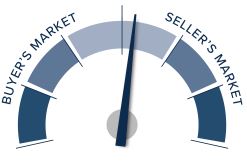
This speedometer reflects the state of the region’s real estate market using housing inventory, price gains, home sales, interest rates, and larger economic factors.

This speedometer reflects the state of the region’s real estate market using housing inventory, price gains, home sales, interest rates, and larger economic factors.

Although the regional economy is still expanding, it shows signs of slowing. With the probability of a national recession this year now fifty-fifty, I do not see any reason for buyers to lose confidence in their housing decisions based purely on economic factors. Sellers appear to be a little more confident in the market, as shown by rising listing prices. Periods of lower mortgage rates and the lack of homes for sale are likely contributors to this. Whatever the case, I am not seeing any signs of panic in the market.

Even in the face of higher financing costs, low inventory levels support home values, and the data suggests that the worst of the price declines are now behind us. The region had fewer sales, modestly lower prices, and higher average days on market, all favoring home buyers. However, lower inventory levels, higher pending sales, higher listing prices, and a higher absorption rate of homes for sale favor sellers. As such, I am moving the needle towards a balanced market, but one that ever so slightly favors sellers.


ABOUT MATTHEW GARDNER

Matthew Gardner - Chief Economist for Windermere Real Estate

As Chief Economist for Windermere Real Estate, Matthew Gardner is responsible for analyzing and interpreting economic data and its impact on the real estate market on both a local and national level. Matthew has over 30 years of professional experience both in the U.S. and U.K.

In addition to his day-to-day responsibilities, Matthew sits on the Washington State Governors Council of Economic Advisors; chairs the Board of Trustees at the Washington Center for Real Estate Research at the University of Washington; and is an Advisory Board Member at the Runstad Center for Real Estate Studies at the University of Washington where he also lectures in real estate economics.


This post originally appeared on the Windermere.com Blog.

For Home Owners • For Sellers • Kari's Blog • April 25, 2023

Making Your Home a Healthy Place

Most of us spend a good deal of our lives at home, so of course, we want it to be a healthy place. Some improvements can be made quickly and easily, and others require more time, money, and effort, but there’s always something you can do to make your home a healthier place to live.

Do it yourself, or get a pro?

Healthy upgrades can be done on a large or small scale. If you’re planning to sell your home in the next five years, it’s a good idea to have value-boosting changes made with future buyers in mind.

For example, if you notice mold around your windows, they likely need replacing. Unless you have some carpentry experience, this is a job for the pros. If your windows are in good shape, but you want to have more control over light, temperature extremes, privacy, and the view, consider top-down-bottom-up shades. While you might enjoy selecting the perfect blinds for your home, many stores offer great deals, including installation, which could save you a lot of headaches.

If you have any leaky faucets or plumbing fixtures that no longer work as they should, have them replaced by professional plumbers. If the exhaust fan over your stove is not properly vented to the outdoors, then you are bringing particulates from cooking right back into your home and redistributing them. Installing or remediating an exhaust fan is a job for a pro.

Many things you can do yourself

So many upgrades to make your home a healthier place can easily be done by you. For example, you can purchase a free-standing air purifier and try it out in several rooms. Some plants actually cleanse the air of pollution, and investing in a few of these is a great idea.

Make sure the curtains or blinds in your bedroom completely block out all light in order to get the best possible sleep. Moving TVs and computers out of your bedroom is another way to ensure better sleep. Replace any Teflon or non-stick cookware with stainless steel or cast iron to avoid having your food absorb toxic chemicals from the coatings. Consider shifting to the use of natural cleaning products, such as baking soda and vinegar. Switch out candles made from petroleum-based paraffin to some that are soy-based–they’ll burn cleaner and emit fewer noxious chemicals.

Designing a healthy home office

Your home office shouldn’t be in your bedroom or living room if you want it to be efficient. It’s ideal to put it in a location with plenty of natural light, preferably coming in from two different sides of the room. Since natural light is known to increase productivity and concentration, choose window coverings that allow you to let the light in. Make sure that your desk and office chair are both the right height for you to avoid ergonomic issues, such as carpal tunnel. Make sure your office space is appealing, after all, you’ll be spending a good bit of time there.

There are many changes, both big and small, that can be made in your home to make it a healthier place to live. Start small, for example, by instituting a no-shoes rule and providing a place for everyone to leave their shoes upon entry. Before you invest in big remodeling projects, it might be worthwhile to check with a successful local realtor to find out what features are most appealing to current buyers. You may not want those features in your home, but then again, you might. While you are overhauling the healthy aspects of your home, it’s a great time to create a home office with the same parameters of maintaining good health in mind. Maintaining a healthy living and/or working space is an ongoing project that will pay off for years.


Planning on selling or buying a home? Contact the Kari Haas Real Estate Team for exceptional service.

Image courtesy of Pexels.

This post was written by Micah Norris for the Kari Haas Real Estate Team blog.

For Buyers • For Home Owners • For Sellers • Real Estate Market Updates & Insight • April 12, 2023

April 2023 Real Estate Market Update

Spring has truly arrived in our region, with longer days and blooming cherry blossoms. Along with these harbingers of the season, the pace of the local real estate market has also picked up, indicating that the spring market is finally here. An uptick in new listings and price gains in the last month demonstrates a typical seasonal pattern, and buyers and sellers are adjusting their strategies accordingly.

According to Windermere’s Chief Economist Matthew Gardner, the total inventory in King, Snohomish, and Pierce counties grew over 14% from February. However, the number of homes for sale in the tri-county area was down about 40% when compared to pre-pandemic stats from March 2019. This gives sellers the advantage when it comes to setting prices for their listings.

Gardner noted this as well. “Despite the growing number of available homes for sale, sellers in King County are holding firm, with listing prices increasing by over 5% compared to February. In Snohomish County, listing prices were up just shy of 5%,” he said.

While the monthly increase in listings is good news for buyers, fluctuating interest rates and steadfast prices from sellers mean some borrowers are getting creative with their financing. Bridge loans, home equity loans, and purchases contingent on the sale of the buyer’s previous home are coming back into circulation.

These factors and more are that buyers are eager to take advantage of the market when interest rates dip down to more comfortable levels. As rates continue to fluctuate and gradually level off, prices may once again become the major determining factor for which listing a buyer may pursue.

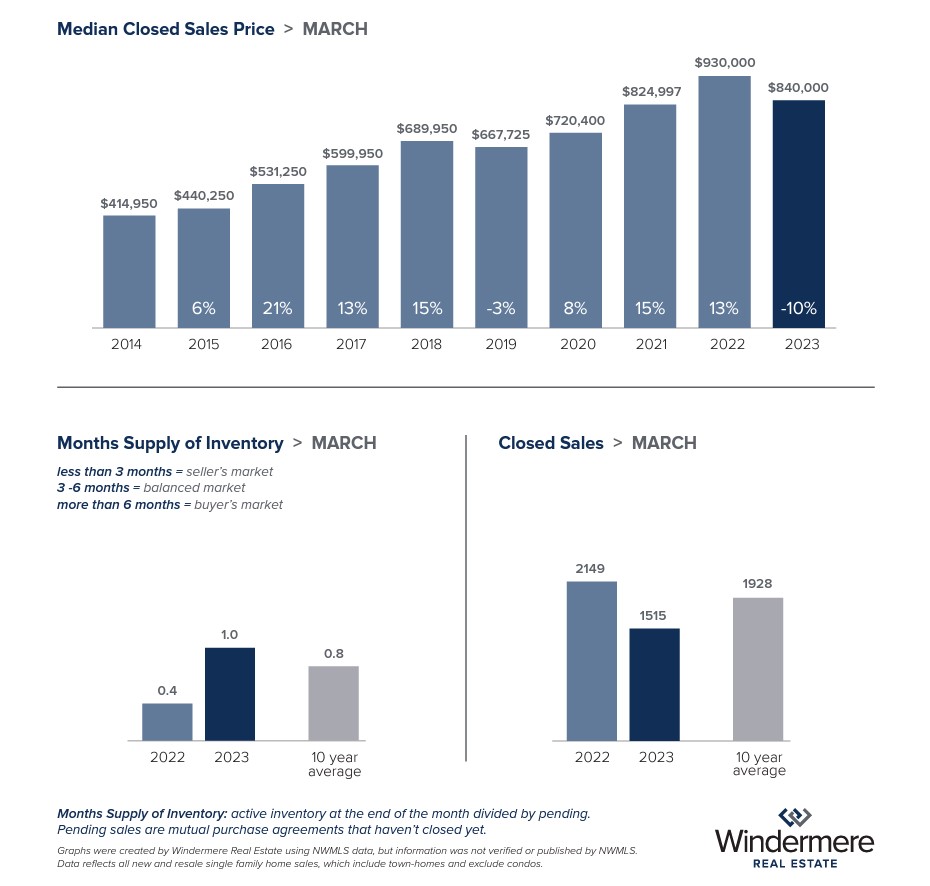
In King County, the median price for a single-family home rose about 4.8% from $800,000 in February to $840,000 last month. While that’s still down 9.68% from the median price of $930,000 in March 2022, steady price growth in the face of higher interest rates is certainly notable. With about one month of inventory, the ball is still in the sellers’ court, despite lower year-over-year prices.

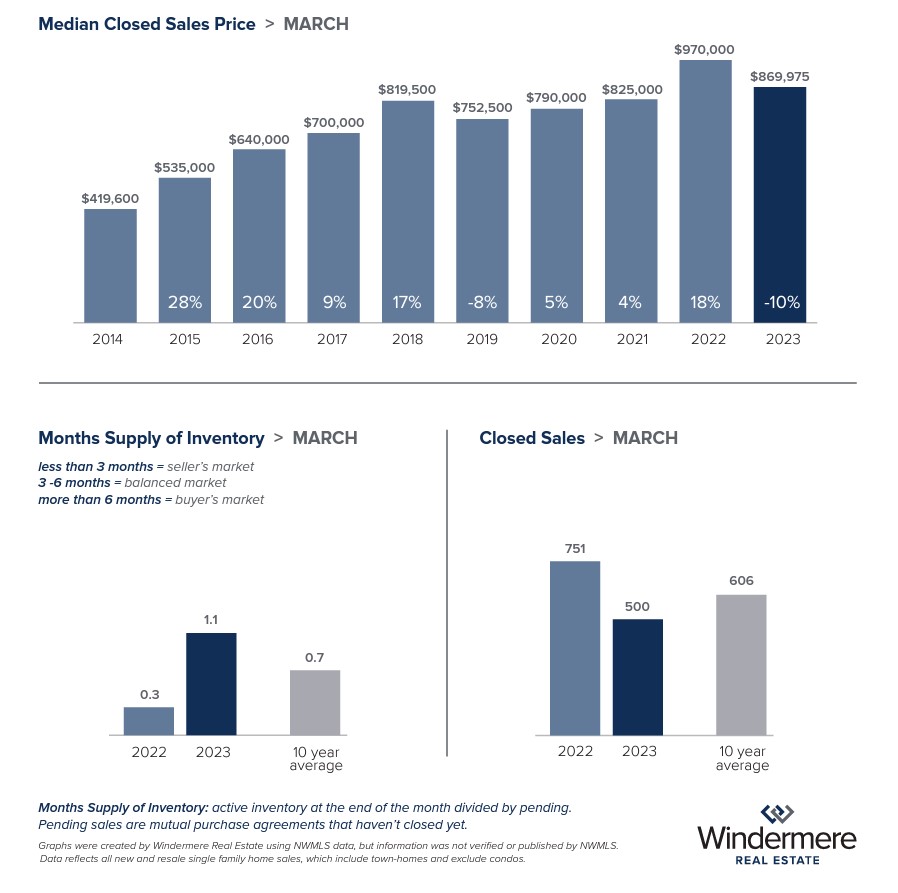
Seattle followed a similar pattern. The median price for single-family homes dropped 10.3% from $970,000 in March 2022 to $869,975 last month. However, that’s an increase of over 5% from February’s median price of $825,000. The condo market saw year-over-year gains of 4.9%, increasing from a median price of $510,025 in March 2022 to $535,000 last month. The residential market still had relatively tight inventory at about 1.1 months’ supply. However, compared to the scant .3-month’s supply of March 2022, buyers seem to have their pick of listings.

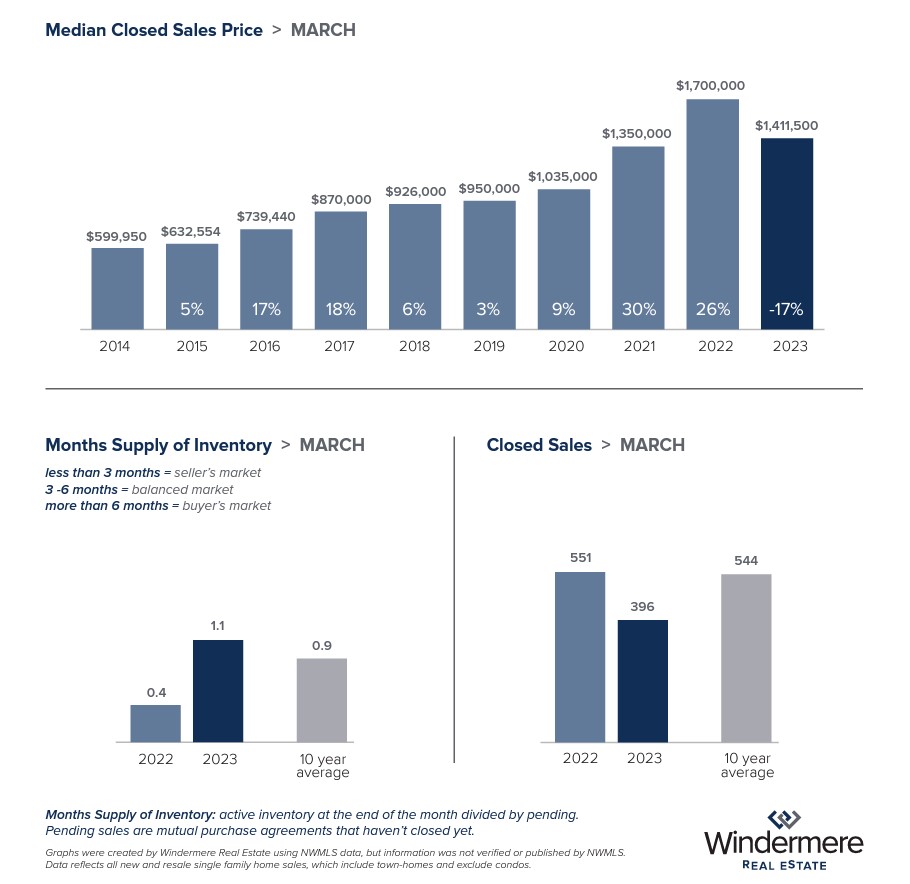
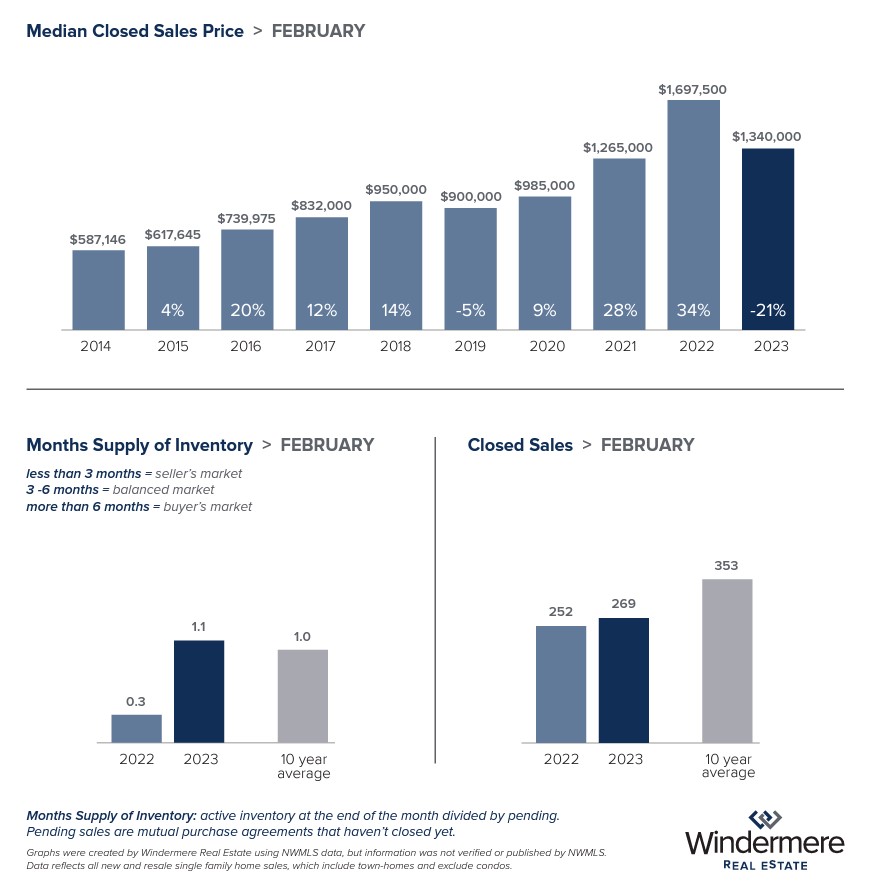
The Eastside saw the greatest year-over-year price decrease, which is to be expected considering the already high price point of the area. While the median single-family home price decreased almost 17% from $1,700,000 in March 2022 to $1,411,500 last month, the area did see monthly gains; the median price increased just over 5% from $1,340,000 in February. Condos in the area also had monthly increases, from a median price of $540,000 in February to $585,000 last month.

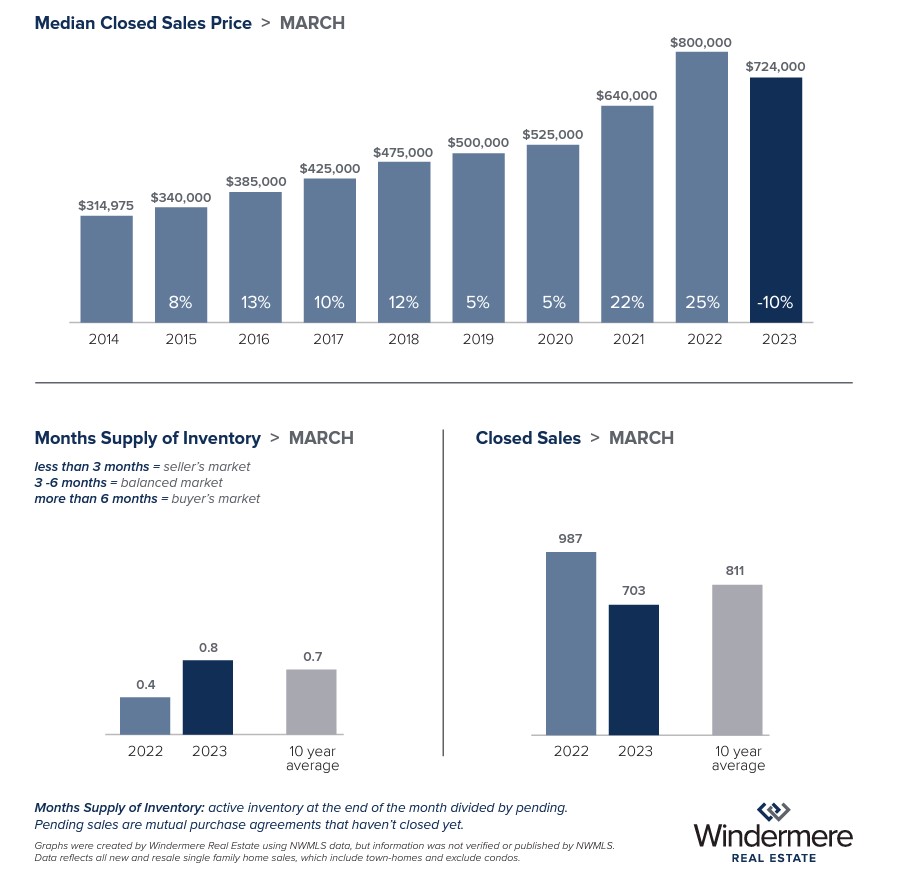
Snohomish County — while still more affordable than its neighbors — was up compared to February. Last month, the median price for single-family homes in the area was $724,000, up from $690,560 in February. The area had the smallest relative year-over-year price decrease of 9.5%, coming down from a median of $800,000 in March 2022. With just .8 months of inventory, Snohomish is still a desirable area for buyers looking to get the most bang for their buck.

Over the last few weeks, tapering interest rates have brought buyers back to the market, but low inventory remains a key challenge for prospective buyers moving forward. If you’d like to learn more about what these market conditions mean for you, please reach out to Kari at (206)719-2224


EASTSIDE

VIEW FULL EASTSIDE REPORT


KING COUNTY

VIEW FULL KING COUNTY REPORT


SEATTLE

VIEW FULL SEATTLE REPORT


SNOHOMISH COUNTY

VIEW FULL SNOHOMISH COUNTY REPORT


This post originally appeared on GetTheWReport.com.

Kari's Blog • March 22, 2023

Your Ultimate Spring Maintenance Checklist for a Safe and Comfortable Home

As winter fades and spring blooms, it’s time to give your home a little extra attention to ensure it is in top shape for the upcoming warmer months. A little maintenance now can go a long way in preventing costly repairs and ensuring your family’s safety and comfort. Here are ten spring maintenance tasks you should consider:

1. Check Your Roof

Inspect your roof for any damage that may have occurred during the winter. Look for missing or damaged shingles, leaks, and signs of wear and tear. Hire a professional to repair any damage and ensure your roof is ready to withstand the upcoming weather.

2. Clean Gutters and Downspouts

Clear out any debris, leaves, or branches that may have accumulated in your gutters and downspouts over the winter months. Clogged gutters can cause water damage to your home and can even lead to foundation problems. Consider installing gutter guards to prevent debris buildup.

3. Check Your HVAC System

Schedule a professional HVAC inspection and tune-up to ensure your system is working well. This can help improve energy efficiency and prevent any potential breakdowns during the summer months.

4. Service Your Lawn Equipment

Get your lawn mower, trimmer, and other lawn equipment serviced to ensure they are ready for the spring and summer months. Sharpen blades, change oil and filters, and check for any necessary repairs.

5. Inspect Windows and Doors

Check for any gaps or cracks around windows and doors that may have formed over the winter months. These gaps can cause drafts and energy loss, leading to higher energy bills. Seal any gaps with weatherstripping or caulk.

6. Power Wash Exterior Surfaces

Power wash your home’s exterior surfaces to remove any built-up dirt, grime, and stains. This can help improve your home’s curb appeal and prevent damage to surfaces like siding, decks, and patios.

7. Check Smoke and Carbon Monoxide Detectors

Test your smoke and carbon monoxide detectors and replace batteries as needed. These detectors are crucial for keeping your family safe, so ensuring they are in good working order is important.

8. Inspect Your Attic and Insulation

Check your attic for any signs of damage or leaks. Make sure the insulation is evenly distributed and in good condition. Proper insulation can help regulate the temperature in your home and reduce energy costs.

9. Clean Your Chimney

If you have a fireplace or wood stove, hire a professional to clean and inspect your chimney. Creosote buildup can be dangerous and lead to chimney fires, so it’s important to have it cleaned regularly.

10. Check Your Outdoor Lighting

Ensure your outdoor lighting is in good working order, and replace burnt-out bulbs. Good outdoor lighting can improve the safety and security of your home, especially as the days get longer and you spend more time outdoors.


Following these ten spring maintenance tasks ensures your home is safe, comfortable, and efficient for the warmer months. Don’t hesitate to hire professionals for inspections and repairs when needed. You can enjoy a stress-free and comfortable season in your well-maintained home with a little effort. If you need recommendations for service providers, contact Kari for our trusted local vendors.

For Buyers • For Home Owners • For Sellers • Real Estate Market Updates & Insight • March 10, 2023

March 2023 Real Estate Market Update

A recent surge in purchase activity indicates that the early spring real estate market is in full swing in our region. Fluctuating interest rates have caused some buyers to converge on properly-priced listings when rates are down, while potential sellers have been hesitant to let go of the historically low mortgages they have on their homes. This has led to a well-known dynamic in our region: not enough inventory to meet the current demand, causing buyers to compete again in multiple offer scenarios. The likely effect of this push-pull will be higher prices in the coming months, despite the constraints of higher (and unpredictable) mortgage rates.

The current interest rate environment is the difference between the level of competition the market is experiencing now and the frenzy of the pandemic market. Buying power is lessened by higher mortgage payments, and with rates still in flux, creative financing is key for many buyers.

That being said, Windermere’s Chief Economist Matthew Gardner notes buyers are eager to take advantage of brief dips in rates when they appear. “What is interesting is that home prices rose between January and February, which tells me that buyers jumped on the opportunity to take advantage of mortgage rates that dipped below 6.1% five times between mid-January end early February,” Gardner said.

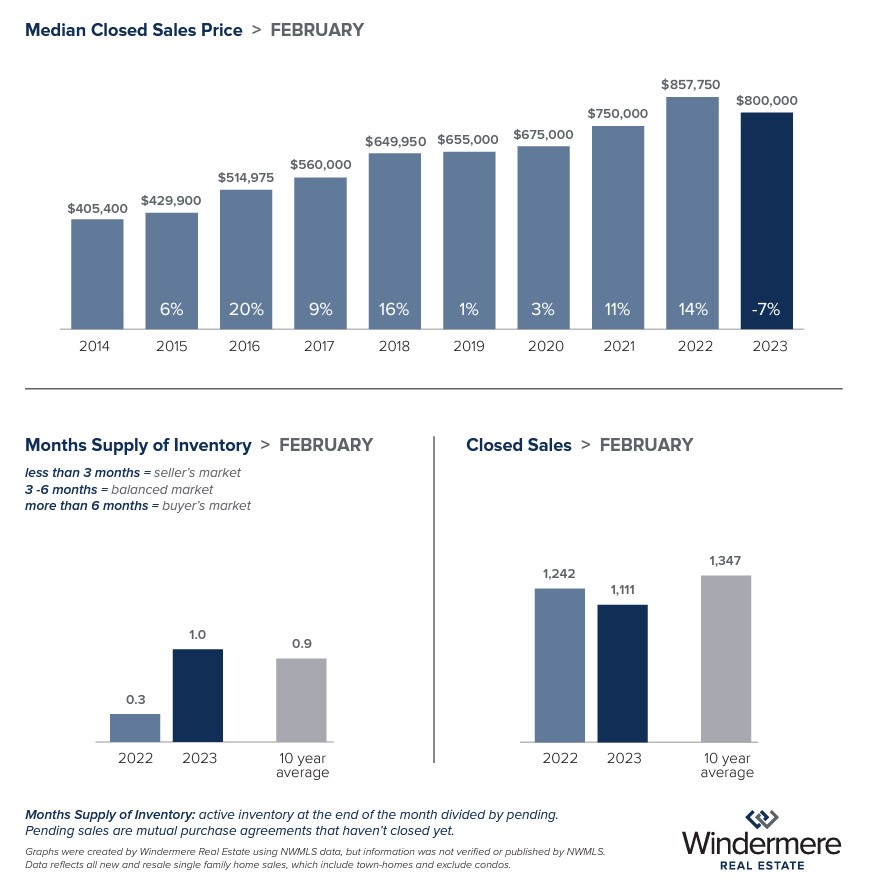
In King County, single-family home prices did rise from $781,098 in January to $800,000, though that’s down 6.7% from $857,750 in February 2022. Condos were also up, with a median price of $468,500 last month compared to $450,000 in January.

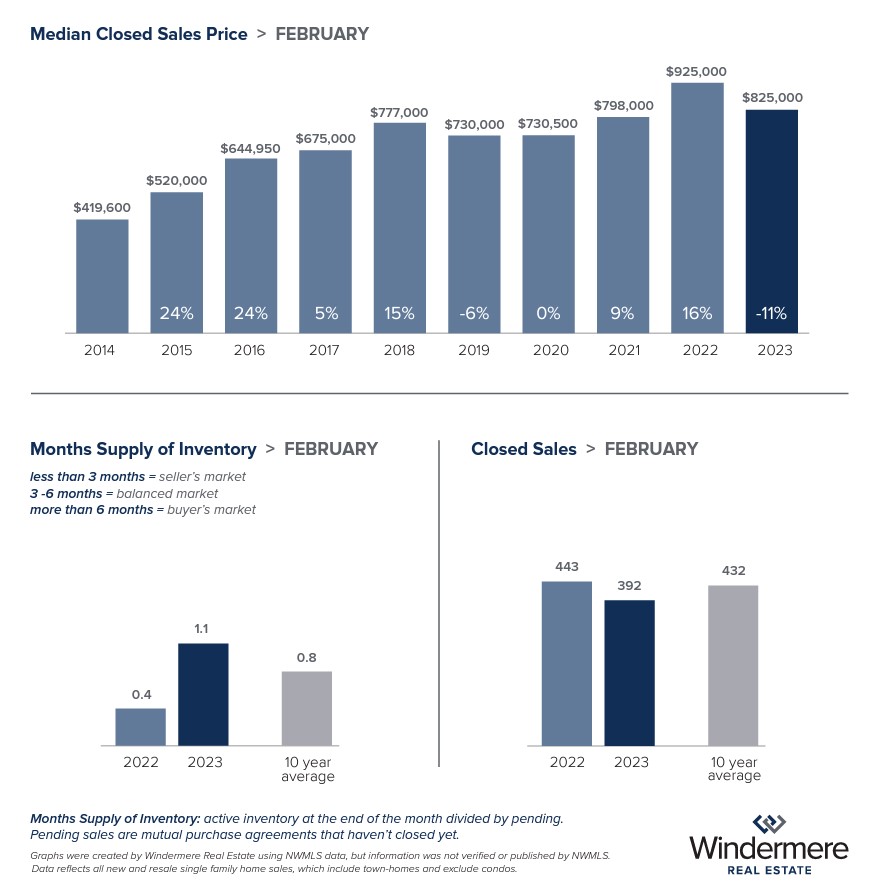
Seattle followed the same pattern, with the median price of single-family homes rising from $803,750 in January to $825,000 last month. While that is still down 11% from $925,000 this time last year, interest rates have played a large part in what buyers can reasonably afford. In the last two years alone, the median interest payment for a single-family home has risen 54%, from $3,283 in February 2021 to $5,085 — an increase of $1,802. Despite this, demand is still high, as buyers do what they can to break into the market. In February, 28% of Seattle homes sold above list price, and 53% of listings sold in under two weeks.

On the Eastside, the median price of a single-family home last month was $1,340,000 — down over 21% from a year ago, when the median was $1,697,500. However, February sold prices were up from January when the median was $1,320,000. A sure sign that the Eastside market is becoming more competitive, in the last three months, both the number of homes selling above the asking price and the amount over list price have doubled.

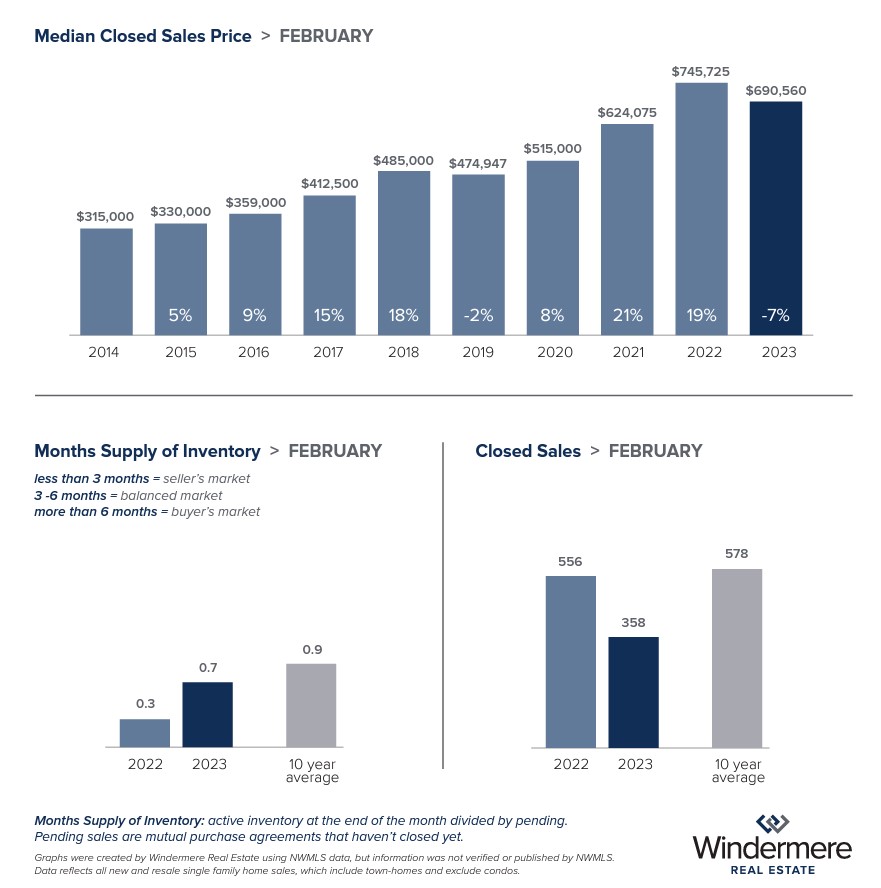
In Snohomish County, the median price for single-family homes fell 7.4% year-over-year to $690,560. Unlike the other regions, that’s also down from January’s median price of $699,000. The higher interest rates could be causing more buyers in this market to pause as they wait for prices and rates to stabilize. The relative affordability of Snohomish County has long been a draw for many buyers, who now may be more sensitive to the fluctuations of the market.

Looking ahead, Matthew Gardner predicts we will see more of the same trends. “Year over year, home sales prices are down, but that isn’t surprising given that a year ago, homebuyers were scrambling to buy in the face of mortgage rates that were about to skyrocket,” he said. “I expect we will see a similar story for the next few months.”

If you have questions about what these market conditions mean for you, please give the Kari Haas Real Estate Team a call!


EASTSIDE

VIEW FULL EASTSIDE REPORT


KING COUNTY

VIEW FULL KING COUNTY REPORT


SEATTLE

VIEW FULL SEATTLE REPORT


SNOHOMISH COUNTY

VIEW FULL SNOHOMISH COUNTY REPORT


This post originally appeared on GetTheWReport.com.

Kari's Blog • February 14, 2023

February 2023 Real Estate Market Update

Spring may have come early to the local housing market, with home sales increasing and multiple offers sneaking back into the norm after a downturn over the last few months. While still not at the levels of the peak pandemic market, buyers are actively competing with one another again, as mortgage rates and prices have come down in King and Snohomish counties. General low inventory on the affordable and mid-price end of the spectrum has also fueled competition.

With the average 30-year fixed-rate mortgage coming down to around 6.09% — about a whole percentage point lower than last November — mortgage payments are more affordable to today’s buyers than they would have been in the fall, especially since home prices in most areas have come down or at the very least flattened. The question will be if today’s conditions fuel enough competition to set prices rising again in the coming months.

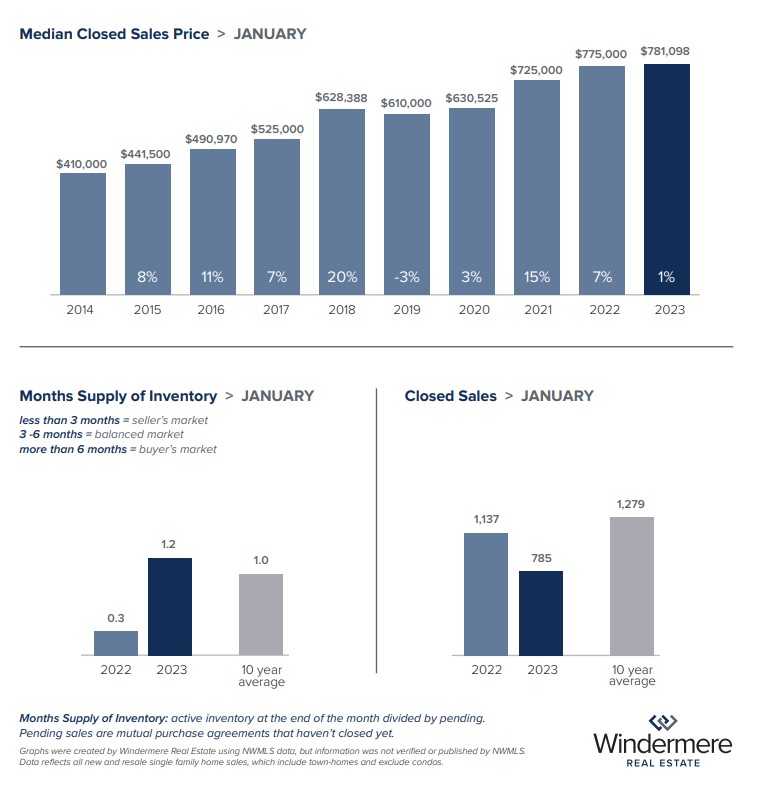
In King County, single-family homes sold for a median of $781,098 in January, up slightly from $775,000 in January of 2022. Of these sold units, 11% closed above list price, and over 30% sold in less than two weeks, markers of some competitive demand in the region. Combining King County condo and residential sales, January’s 1,003 sold units were a 32% drop from the 1,437 closings in December.

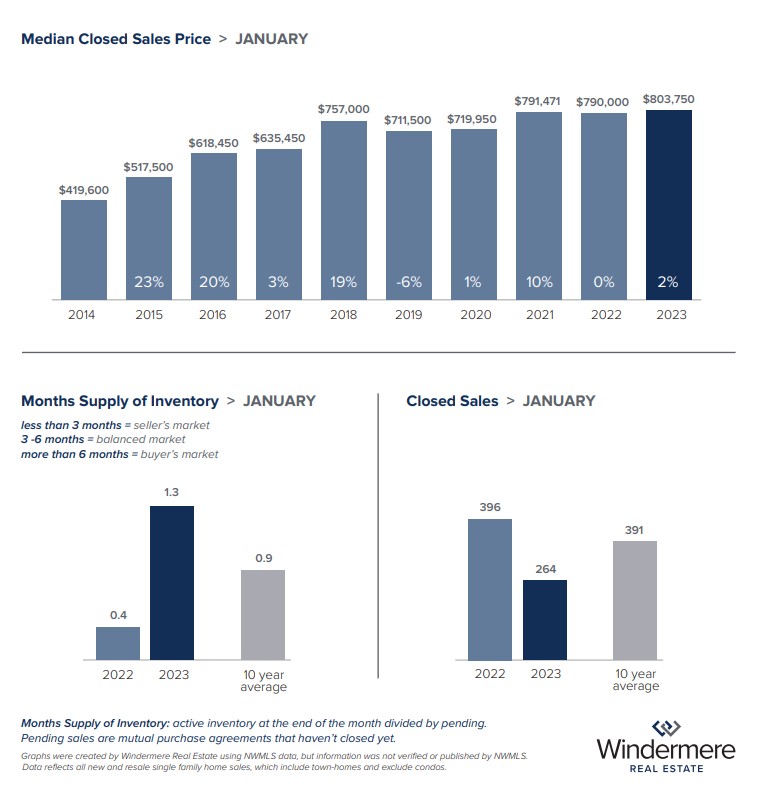
In Seattle, the median price of a single-family home ticked up to $803,750 last month, compared to $790,000 a year ago. Almost 40% of Seattle residential listings sold in less than two weeks, and 13% sold above the list price. With 1.3 months’ inventory, buyers seeking single-family homes have a few more options to choose from than they did a year ago, but the condo market in the city is where they can maximize their buying power even more. The median price for Seattle condos was a relatively affordable $487,500, and, with 2.1 months of inventory on the market, condo buyers may have an easier path to purchase for the time being.

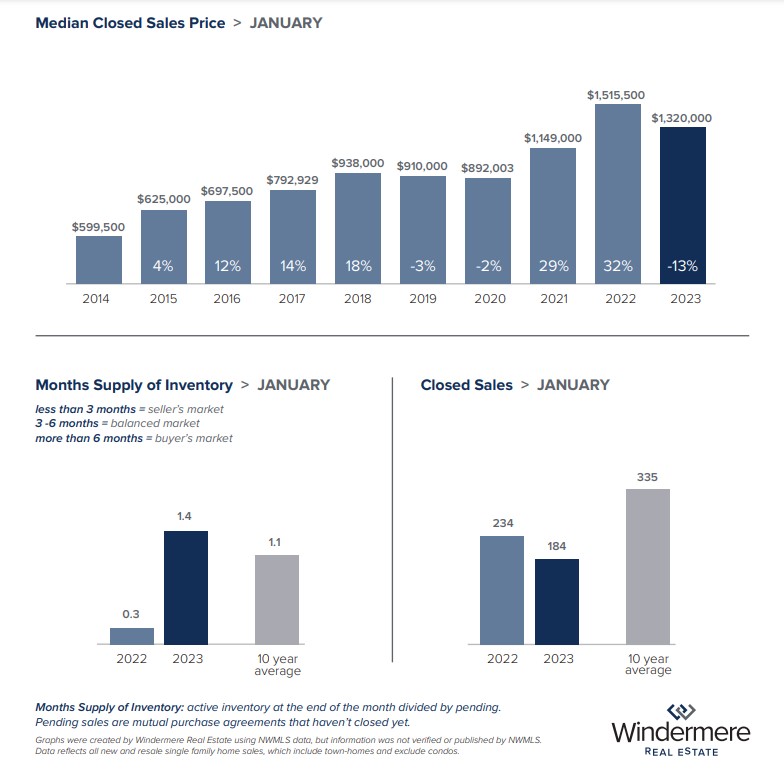
On the Eastside, prices continued to stabilize at a lower level than we saw during the pandemic. The median price of a single-family home in the area was $1,320,000 in January, down 13% from $1,515,500 in January 2022. Like Seattle, the Eastside currently has 1.3 months supply of homes. While only 8% of homes sold over list price in January, nearly 30% sold in two weeks or less, indicating healthy buyer demand for correctly priced Eastside homes.

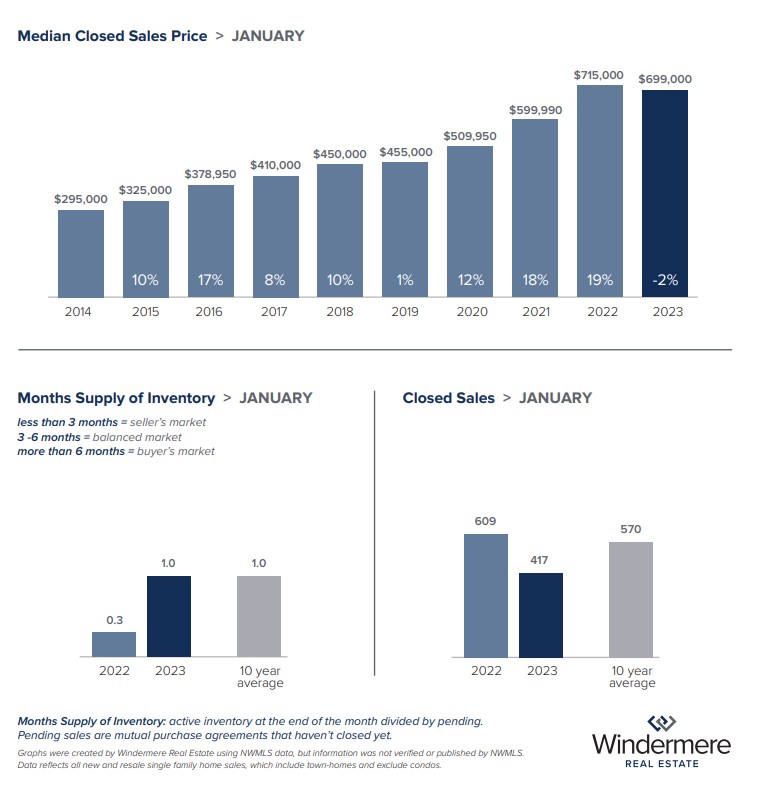
Snohomish County remains a more affordable alternative to Seattle and the Eastside, with the median single-family home price dropping to $699,000 last month. That’s down from $715,000 the same period the previous year. In addition, the county has the smallest amount of inventory, with a single month’s supply of listed homes. Of the closed sales, 34% sold in less than two weeks — reinforcing the fact that many buyers are prepared to move quickly in a hastening market.

According to Windermere’s Chief Economist Matthew Gardner, taking an annual average “is better than comparing this month to this month.” For example, inventory across the Puget Sound region is up almost 200% year-over-year. Compared to the number of active listings during the last pre-pandemic year, the current number falls by about 30%. This indicates plenty of room for a competitive market in the months ahead.

If you have questions about these housing market trends or other real estate topics, please reach out to our team.


EASTSIDE

VIEW FULL EASTSIDE REPORT


KING COUNTY

VIEW FULL KING COUNTY REPORT


SEATTLE

VIEW FULL SEATTLE REPORT


SNOHOMISH COUNTY

VIEW FULL SNOHOMISH COUNTY REPORT


This post originally appeared on GetTheWReport.com.

Kari's Blog • January 27, 2023

Q4 2022 Western Washington Gardner Report

The following analysis of the Western Washington real estate market is provided by Windermere Real Estate Chief Economist Matthew Gardner. We hope that this information may assist you with making better-informed real estate decisions. For further information about the housing market in your area, please don’t hesitate to contact Kari Haas.

REGIONAL ECONOMIC OVERVIEW

Although the job market in Western Washington continues to grow, the pace has started to slow. The region added over 91,000 new jobs during the past year, but the 12-month growth rate is now below 100,000, a level we have not seen since the start of the post-COVID job recovery. That said, all but three counties have recovered completely from their pandemic job losses, and total regional employment is up more than 52,000 jobs. The regional unemployment rate in November was 3.8%, which was marginally above the 3.7% level of a year ago. Many business owners across the country are pondering whether we are likely to enter a recession this year. As a result, it’s very possible that they will start to slow their expansion in anticipation of an economic contraction.

WESTERN WASHINGTON HOME SALES

❱ In the final quarter of 2022, 12,711 homes were sold, representing a drop of 42% from the same period in 2021. Sales were 34.7% lower than in the third quarter of 2022.

❱ Listing activity rose in every market year over year but fell more than 26% compared to the third quarter, which is expected given the time of year.

❱ Home sales fell across the board relative to the fourth quarter of 2021 and the third quarter of 2022.

❱ Pending sales (demand) outpaced listings (supply) by a factor of 1:2. This was down from 1:6 in the third quarter. That ratio has been trending lower for the past year, which suggests that buyers are being more cautious and may be waiting for mortgage rates to drop.

WESTERN WASHINGTON HOME PRICES

❱ Sale prices fell an average of 2% compared to the same period the year prior and were 6.1% lower than in the third quarter of 2022. The average sale price was $702,653.

❱ The median listing price in the fourth quarter of 2022 was 5% lower than in the third quarter. Only Skagit County experienced higher asking prices. Clearly, sellers are starting to be more realistic about the shift in the market.

❱ Even though the region saw aggregate prices fall, prices rose in six counties year over year.

❱ Much will be said about the drop in prices, but I am not overly concerned. Like most of the country, the Western Washington market went through a period of artificially low borrowing costs, which caused home values to soar. But now prices are trending back to more normalized levels, which I believe is a good thing.

MORTGAGE RATES

❱ Rates rose dramatically in 2022, but I believe that they have now peaked. Mortgage rates are primarily based on the prices and yields of bonds, and while bonds take cues from several places, they are always impacted by inflation and the economy at large. If inflation continues to fall, as I expect it will, rates will continue to drop.

❱ My current forecast is that mortgage rates will trend lower as we move through the year. While this may be good news for home buyers, rates will still be higher than they have become accustomed to. Even as the cost of borrowing falls, home prices in expensive markets such as Western Washington will probably fall a bit more to compensate for rates that will likely hold above 6% until early summer.

DAYS ON MARKET

❱ It took an average of 41 days for homes to sell in the fourth quarter of 2022. This was 17 more days than in the same quarter of 2021 and 16 days more than in the third quarter of 2022.

❱ King County was again the tightest market in Western Washington, with homes taking an average of 31 days to find a buyer.

❱ All counties contained in this report saw the average time on the market rise from the same period a year ago.

❱ Year over year, the greatest increase in market time was in Snohomish County, where it took an average of 23 more days to find a buyer. Compared to the third quarter of 2022, San Juan County saw the average market time rise the most (from 34 to 74 days).

CONCLUSIONS

This speedometer reflects the state of the region’s real estate market using housing inventory, price gains, home sales, interest rates, and larger economic factors.

The regional economy is still growing, but it is showing signs of slowing. Although this is not an immediate concern, if employees start to worry about job security, they may decide to wait before making the decision to buy or sell a home. As we move through the spring, I believe the market will be fairly soft, but I would caution buyers who think conditions are completely shifting in their direction. Due to the large number of homeowners who have a mortgage at 3% or lower, I simply don’t believe the market will become oversupplied with inventory, which will keep home values from dropping too significantly.

Ultimately, however, the market will benefit buyers more than sellers, at least for the time being. As such, I have moved the needle as close to the balance line as we have seen in a very long time.


ABOUT MATTHEW GARDNER

Matthew Gardner - Chief Economist for Windermere Real Estate

As Chief Economist for Windermere Real Estate, Matthew Gardner is responsible for analyzing and interpreting economic data and its impact on the real estate market on both a local and national level. Matthew has over 30 years of professional experience both in the U.S. and the U.K.

In addition to his day-to-day responsibilities, Matthew sits on the Washington State Governors Council of Economic Advisors, chairs the Board of Trustees at the Washington Center for Real Estate Research at the University of Washington, and is an Advisory Board Member at the Runstad Center for Real Estate Studies at the University of Washington where he also lectures in real estate economics.


This post originally appeared on the Windermere.com Blog.

Kari's Blog • January 25, 2023

5 Tips for Homeowners Turning Their Property Into a Rental

Turning a starter home into a rental property is standard practice. If you’re considering moving and have decided to rent rather than sell, there are a few things you can do to improve your home and make it more renter-friendly. The Kari Haas Real Estate Team lists a few simple tips to help you get the most out of your rental.

  1. Make All the Repairs

If you want to charge more rent, you need to create a high-value space. This means making all the necessary repairs and ensuring the work is top-quality. For example, paint everything properly, including taping off wall molding and windows. Also, give everything a deep clean.

For larger projects or jobs that are out of your DIY scope, hire professionals to inspect and repair any electrical or home system issues. Plumbing repairs are certainly best left to the pros, as you don’t want to risk cracking a pipe or fitting and having a flood on your hands. Keep in mind that local companies can help with that. Plumbing pros will come with the proper tools and skill set to get the job done right and quickly. Be sure to read up on customer ratings and reviews before getting quotes from contractors. Slacking on repairs makes you look bad as a landlord and can make tenants second-guess your abilities. If you need to hire a professional but don’t know where to start, the Kari Haas Real Estate Team has a list of highly recommended professionals that we work with regularly.

  1. Assess Your Availability

Part of the renting process is being available for your tenants and managing the property. Before you choose this option, make sure you have the time and money to fill the landlord position. Keeping a rental property means taking on additional home repairs, major and minor, that cut into your budget. If being a full-time landlord would stretch you too thin, consider hiring a property management company to help you collect the rent, arrange a maintenance staff, and vet tenants for any rental history violations.

  1. Make Renovations That Add Value

When making renovations, choose areas of the home that add value. For example, the kitchen and bathrooms are high-value areas. You can update the appliances and countertops. If the kitchen cabinets are outdated, a fresh paint job and some new hardware can completely change the appearance. Talk to a real estate attorney about looking over the deed and researching the home for any potential red flags you should check out. You may need a thorough inspection to help you find any major renovations you need to complete the project. This will help you avoid any major repairs once a tenant moves in as well.

  1. Prioritize Curb Appeal

The appearance of the outside of the property is just as important as the inside. If you want to attract renters that will appreciate your home and take excellent care of it, you need to work on curb appeal. The Redbud Group points out that curb appeal tells potential renters what to expect from the interior and helps you stand out among the competition. It’s as simple as adding a fresh coat of paint and planting some fresh grass or shrubs.

  1. Market Your Property on Social Media

Once the property is complete, you’ll have to get the word out that it is available for rent. The University of Alabama at Birmingham notes that social media is a great marketing source and is more relevant than ever. You can use Facebook ads to showcase the space and target potential renters.

As you show the property to prospective renters, be sure to have free business cards available. You want to make it easy for your prospects to contact you, and making custom business cards is easy to accomplish online. The right tools can even store your design so you can revisit it later.

As you navigate the renovations and repairs, you may run into obstacles. As long as your budget is prepared to handle the unexpected, you should be fine. Stay in contact with everyone working on the project and keep your social media marketing plan updated regularly, and you’ll have the space rented in no time.


For expert assistance buying or selling a home in the Greater Seattle area, contact the Kari Haas Real Estate Team today!


Image via Pexels

This post was written by Lisa Walker for the Kari Haas Real Estate Team blog.