About Kari HaasKari's Blog June 17, 2024

A ‘Little Bit’ of Community Service

On June 7th, Kari Haas joined fellow Windermere agents for the annual Windermere Community Service Day. They dedicated their time to support Little Bit Therapeutic Riding Center in Redmond, WA. This event brought together a team of volunteers committed to making a positive impact in their community.

Kari and her colleagues rolled up their sleeves and tackled various projects around the center. They painted fences, landscaped, and cleaned the stables. Their efforts aimed to enhance the facility’s environment, ensuring it remains a safe and welcoming space for its participants and their families.

“Community service is a core value at Windermere, and I am always excited to participate in these events,” Kari said. “The work Little Bit does is incredible, and it’s an honor to support their efforts.”

Little Bit Therapeutic Riding Center creates a community where horses transform the bodies, minds, and spirits of people with disabilities. Moreover, the center offers therapeutic riding and equine-assisted activities that make a significant difference in the lives of its participants.

By the end of the day, volunteers felt a strong sense of accomplishment and camaraderie. Kari and her team left the center in better shape than they found it. They knew their contributions would directly benefit the individuals who rely on Little Bit’s services.

The Windermere team’s efforts help the center maintain its operations and continue offering these valuable services. By volunteering their time, they supported a vital community resource and strengthened their bonds as a team dedicated to giving back.

Join Kari Haas in Supporting Community Service

Kari Haas and the Windermere Real Estate team commit to making a difference in the community. If you’re interested in learning more about their community service initiatives or how you can get involved, reach out to Kari and her team. Together, we can continue to support organizations like Little Bit Therapeutic Riding Center and make a positive impact in our communities.

Kari's BlogReal Estate Related June 10, 2024

Bridging the Gap: Moving Closer to Your Aging Loved One

Having a senior loved one who needs your support can be demanding, especially if you live far away from them. You might feel that your current location is preventing you from meeting their daily needs. Distance can also make it difficult to keep track of their health and well-being. In such situations, moving closer to your loved one can make a positive difference. However, the process of moving can be challenging.


As a Windermere expert in transitional real estate Kari is trained to understand your goals, concerns, and needs—it is a journey we can embark upon together from start to finish. She can provide a customized approach with the patience, professionalism, and respect you deserve. Below are some things to think about as you consider your move forward.

Research Your New Area

Before moving, it’s important to research the area where you plan to relocate. In addition to housing prices, look for amenities that you need, such as hospitals, pharmacies, and grocery stores. Check for proximity to public transportation. Ensure that the place you plan to move to is senior-friendly, safe, and accessible.


Get Preapproved for a Mortgage

If you intend to buy a new house, get pre-approved for a mortgage so that you know how much you can borrow and what homes are within your price range. Work with a reliable and reputable lender who can help you navigate your options and select a mortgage that fits your financial situation.


Keep Communication Open

Moving is a significant change and can cause anxiety, stress, and uncertainty. Therefore, it’s essential to communicate openly with your senior loved one. Discuss your reasons for moving and ask what they think about it. Listen to their concerns and address them as honestly as possible. This way, they will feel included in the process and more willing to accept the move.


Have a Plan to Move Your Business

If you’re a business owner, moving your business can be a daunting task, but with proper planning and organization, it can be done smoothly. It is important to create a detailed plan, communicate with your employees and customers, and enlist the help of professional movers to ensure a successful transition.


Earning a New Teacher Certificate

As a teacher moving to a new state, you may encounter the additional challenge of obtaining a new teaching license to meet local requirements. Fortunately, online learning programs offer a flexible and cost-effective solution for earning your teacher certification.

These programs provide the convenience of flexible scheduling, allowing you to study and complete coursework at your own pace and during times that best fit your busy lifestyle. This flexibility ensures you can efficiently work towards your new certification without disrupting your current professional and personal commitments.


Establish Necessary Boundaries

Establishing clear boundaries when moving closer to a senior loved one is crucial for maintaining a healthy relationship. Open communication, setting expectations, and respecting each other’s needs can help create a balance between providing support and maintaining independence.


Create a Moving Support System

Moving closer to a senior loved one can be overwhelming and challenging. Therefore, it’s essential to create a support network that includes family, friends, and community resources. Look for support groups, caregiver networks, and volunteer organizations to get the help you need.


Furnish Your New Place

While relocating, adding a few useful home products can make your transition smoother and your new place more comfortable. Whether it’s a new coffee maker to start your day right, an efficient storage solution to keep things organized, or a smart home device for added convenience, these additions can make a big difference.

Always make sure to consult unbiased online reviews before purchasing. Online resources offer in-depth product reviews and comparisons, helping you make informed decisions about the best products for your needs and budget.


Take a Break Once in a While

Taking on the responsibility of caring for a senior loved one can be emotionally and physically taxing. It’s crucial to remember that it’s okay to feel overwhelmed at times and to be patient with yourself as you adjust to this new role. Seeking support from friends, family, or caregiver support groups can also provide valuable resources and encouragement during this challenging time.


Moving closer to your aging loved one for extra care is a significant decision that requires careful planning and consideration. By finding a temporary apartment, maintaining open communication, relocating your business, and establishing necessary boundaries, you can successfully bridge the gap and provide the support your loved one needs while preserving your own independence and well-being. Embrace this opportunity to grow closer and strengthen your relationship with your senior family member while ensuring their safety, happiness, and comfort!

For Home OwnersKari's Blog May 31, 2024

Everything You Need to Know About Your Rights as a New Homeowner

Buying a house is an exciting milestone, but it involves understanding your rights as a homeowner. Knowing what you can and cannot do is essential to avoid disputes and exploitation, especially if you’re a first-time homebuyer or newcomer to the area. Discover these common rights to ensure a safer and more enjoyable experience in your new home.

What Are Property Rights?

These rights refer to what you can legally do with your owned property. You earn this once the property is transferred to you with the following:


  • House title: This is a set of rights you have as the legal owner of the property.


  • House deed: Also known as property deed, this document signifies the legal transfer of rights from the seller to you. The deed is vital when determining the chain of homeownership in the county.

Types of Property Rights

Understanding what you can and cannot do with your property is essential. Owning a home isn’t just about having the title — it entails many legal responsibilities and privileges.

1.   Bundle of Rights

This concept refers to your collection of fundamental property rights as the legal owner. The bundle consists of five privileges:

Right of Possession

You have the authority to hold title to your home. However, you can lose this privilege under specific circumstances, such as late mortgage payments or failure to pay property taxes. The lender and tax authorities can take possession if you don’t fulfill your ownership responsibilities.

Right of Enjoyment

This doesn’t mean you can dictate your neighbor’s morning activities because you want a peaceful sleep. However, you have the right to tell them not to damage your trees when spraying herbicides in their yard. The right of enjoyment also assures you can lawfully enjoy your home by throwing a garden party without breaking local laws.

The Right of Disposition

This privilege allows you to sell, pass down or transfer your property to someone else. Whether relocating elsewhere or selling the house, you have the right to evaluate and execute your chosen action. If you owe a mortgage, you must pay it off before you can sell or give away your residence.

Right of Control

You possess the right to control your property, provided you’re following all state and local ordinances, including zoning laws. For instance, you may hold meetings and gatherings but are forbidden to conduct unlawful actions, such as selling drugs.


You can decide to leave the property alone, build a residential unit or generate income from it, but you might not be able to paint your house an eccentric color if it’s against HOA rules.

Right of Exclusion

You exercise your right of exclusion when you choose who can and cannot enter your property. Like most privileges, this comes with exceptions. Law enforcement authorities can enter your home without your permission if they have a warrant. Emergency workers can also get inside if they sense danger inside your household.


You also have the right to keep unwanted trespassers off your land. You may sue for compensation up to three times the value of your loss if the trespasser causes damage, such as cutting down trees or hitting golf balls onto your property. A civil lawsuit against the violator might be appropriate if they engage in invasive activities, such as spying on you through the windows.


However, the intruder may raise several defenses to reduce sanctions. For instance, they may assert that there was no established prohibition on your property or that trespassing was done out of necessity, such as saving a life in danger.

2.   Right to Make Improvements

Expanding your house and upgrading fences are within your home improvement rights. Before starting a construction project, consult your local building authority to assess your ideas for a feasibility check.

3.   Homeowners Association Rights

An HOA is a group of homeowners in a particular area led by a board of neighborhood volunteers. Their task is to oversee events within the community, including maintenance of public spaces, regular trash pickup and establishment of rules. Here are some of the rights you may have within your HOA.


  • Right to change HOA regulations: Homeowners like you can take action if the community deems rules outdated or discriminatory.


  • Right to question fees: Depending on where you live, the HOA fee costs around $100-$700 You and other homeowners can complain if you collectively believe fees are unjust.


  • Right to access documents: You can access financial reports, vendor contracts, HOA tax returns and board meeting agendas.


Approach your HOA’s board of directors and inquire about the existing HOA rules once you settle in your new home. Get involved in public board meetings and activities to get to know your neighbors better.

Know and Protect Your Rights

Understanding your rights and responsibilities as a homeowner helps you know the rules so you’ll never break them. More importantly, having solid knowledge can help protect you and your property from a legal dispute in the future.


This post was written by Evelyn Long for the Kari Haas Real Estate Team blog.
Evelyn Long is the Editor-in-Chief of Renovated Magazine and a writer with a focus in the real estate sector. Her passion is to make the real estate market easier for young homeowners as they navigate buying, maintaining, and selling homes.

Real Estate Market Updates & Insight May 30, 2024

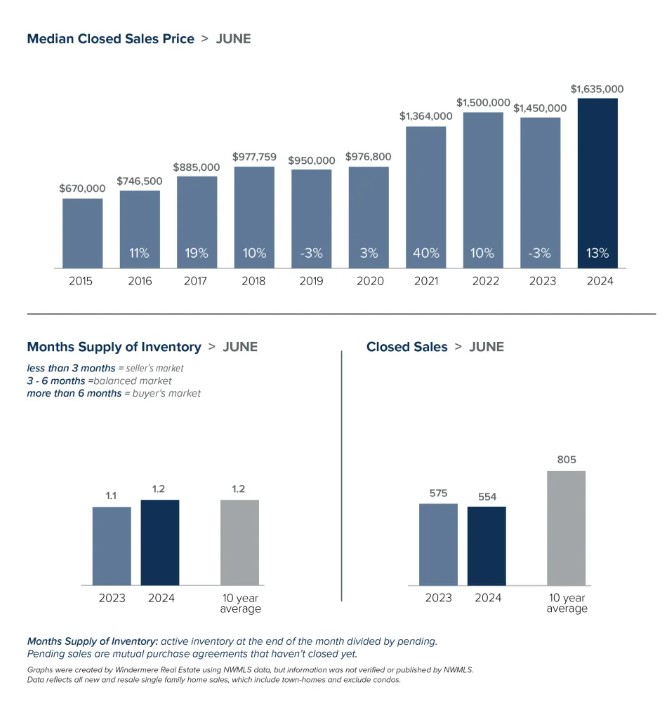
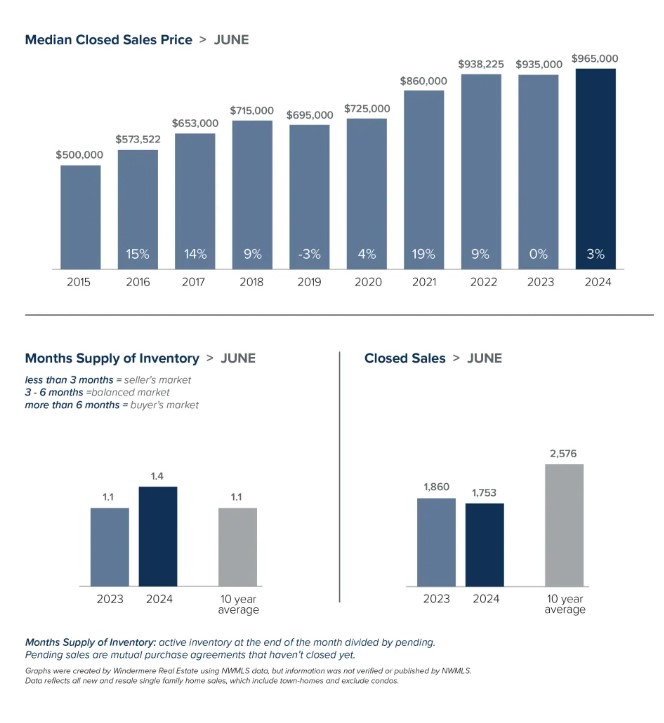
Local Market Update – May 2024

Our local real estate market is exhibiting seasonal strength, with most areas seeing month-over-month and year-over-year sales gains. Despite continued interest rate increases, which can constrain both buyers and sellers, the number of closed transactions in King and Snohomish counties has risen for three straight months. This suggests that both sides of the table are figuring out how to adjust to the higher interest rate environment.

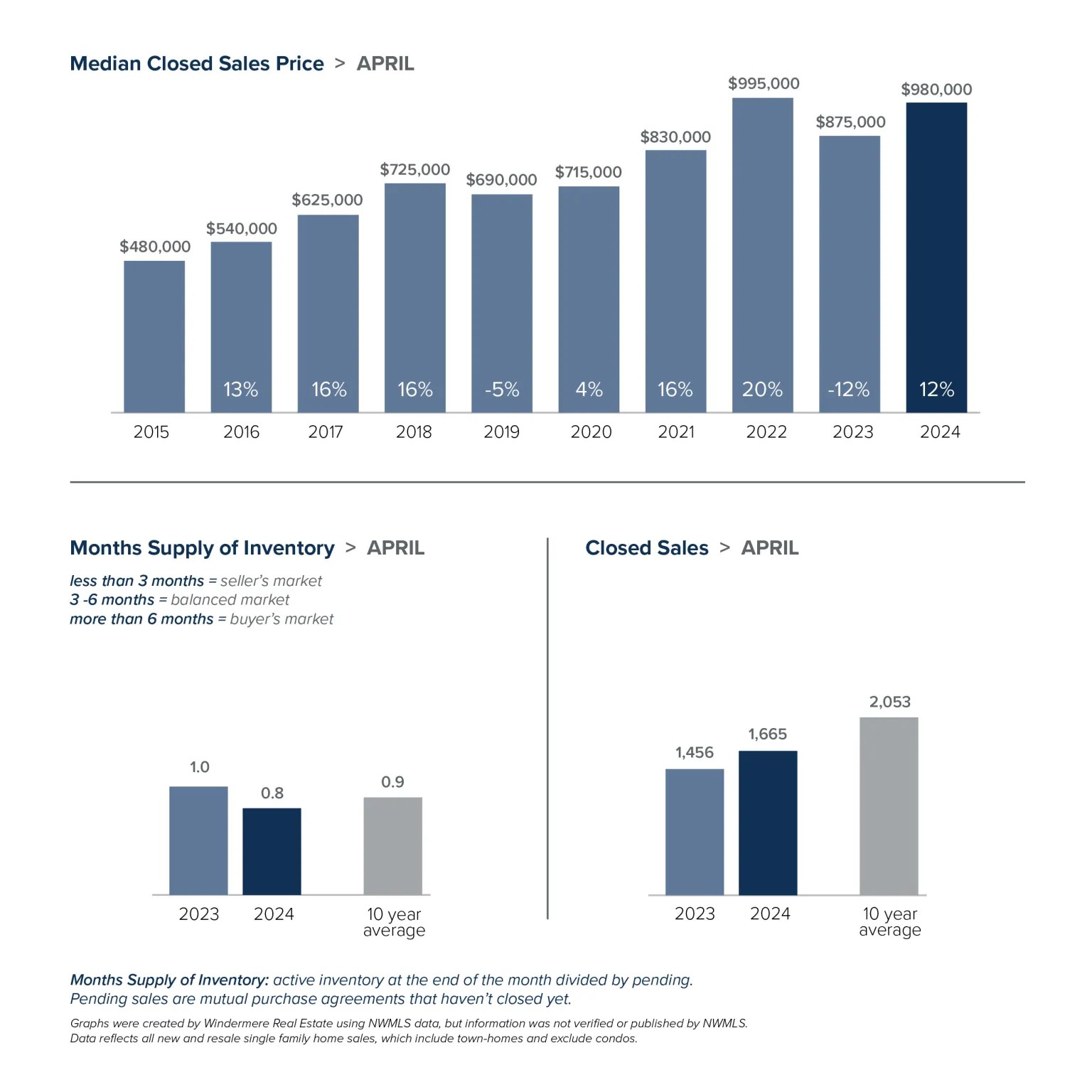
In King County, both home and condo prices soared again last month. The median residential sold price of a single-family home was $980,000, up 12% from April 2023. Despite the rise in interest rates and in light of low inventory, 70% of the country’s home sales closed at or above list price. King County condo prices also rose last month, with the median sold price up 15% from a year ago, to $580,000.

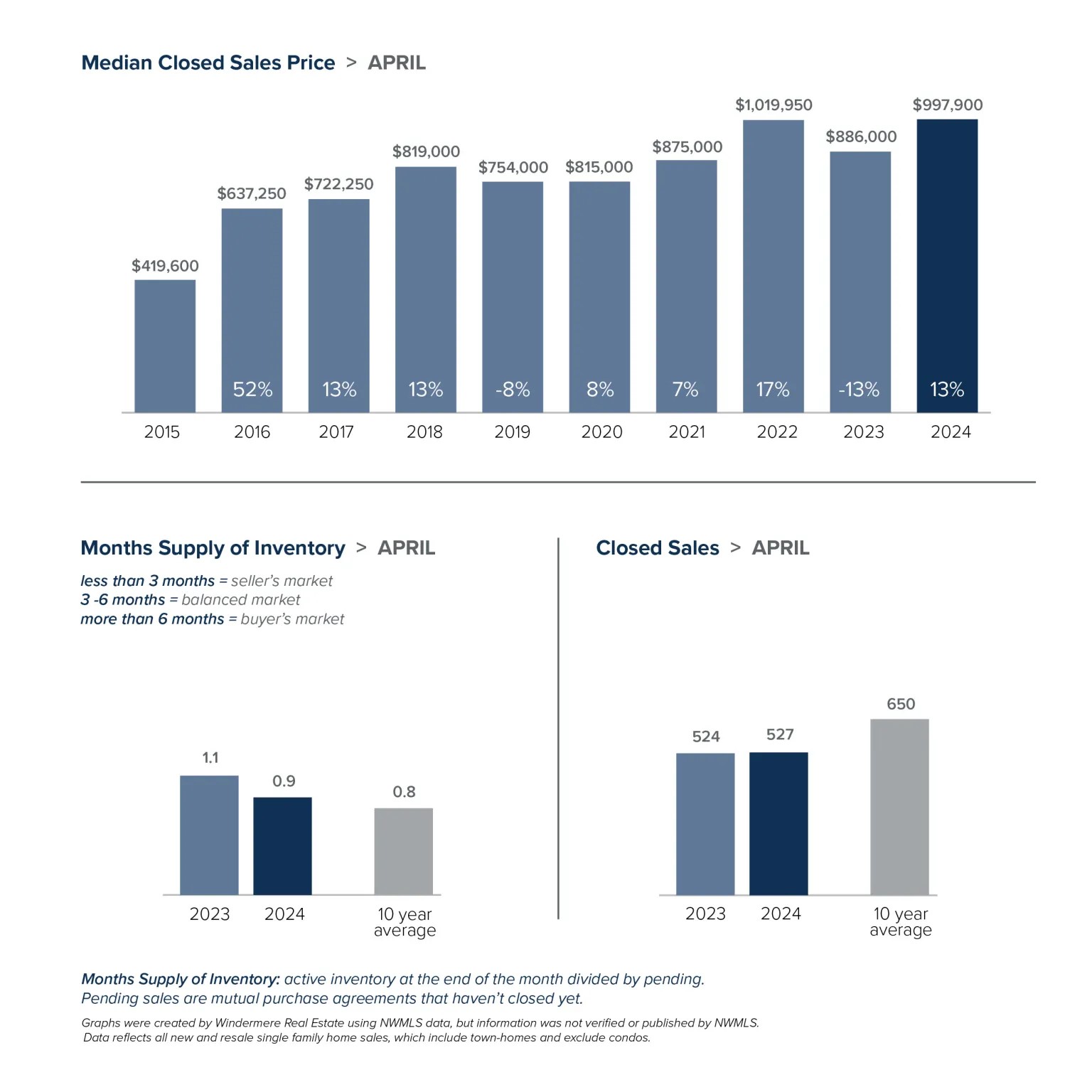
Seattle saw a drop in residential inventory last month, continuing to spur competition among homebuyers for the best listings. The median sold price of a single-family home within the city limits was $997,900 in April, up 13% year over year, and 68% of closed transactions sold at or above the list price. Seattle condo prices rose again, to a median of $599,000, even with 51% more units in play than a year ago.

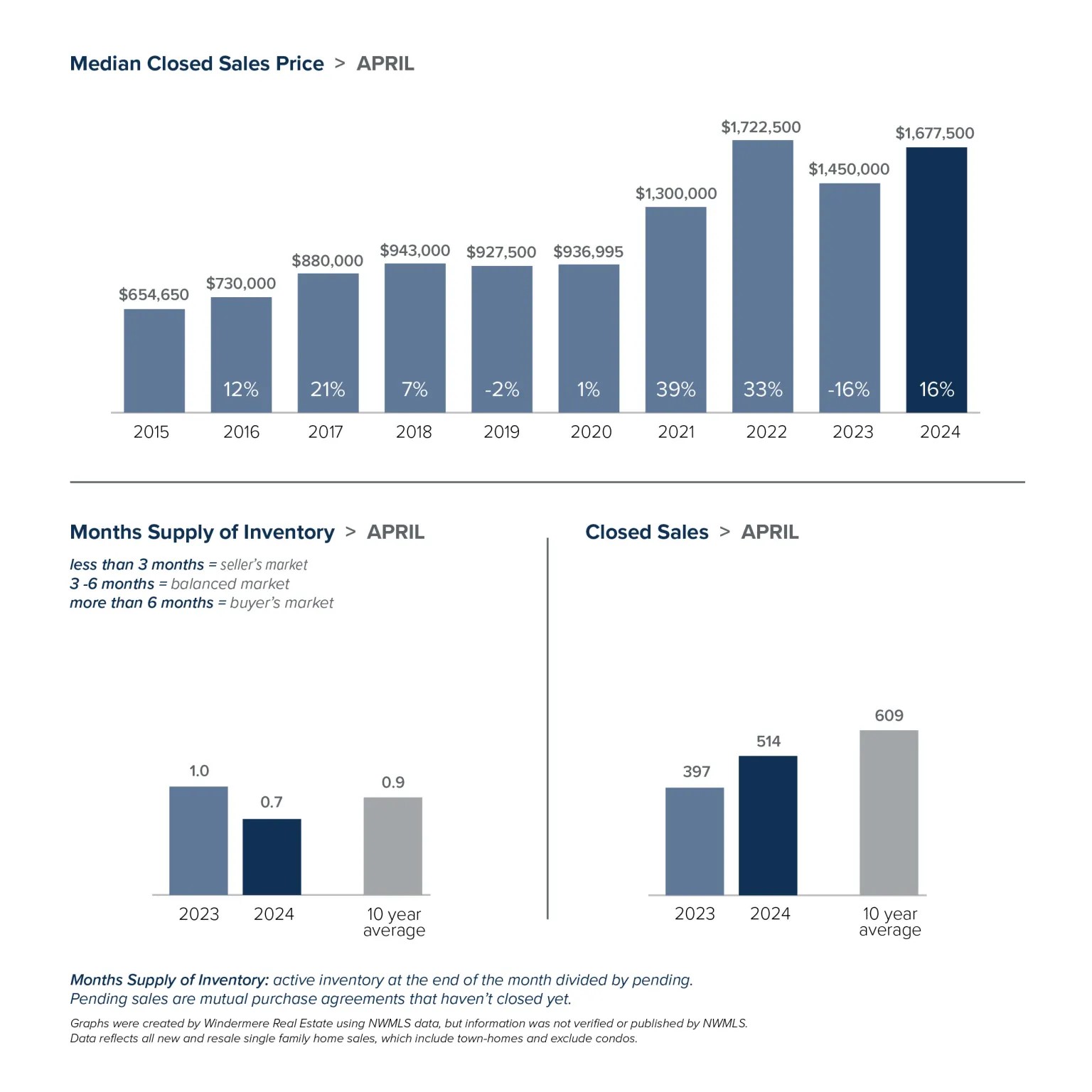
Eastside single-family home prices rose to $1,677,500 last month, up 16% compared to a year ago. Nearly three-quarters of those sales closed at or above list price, likely driven by a 33% year-over-year drop in available supply, which stood at just 0.7 months of inventory by month’s end. Eastside condo prices rose 17% year over year, from $620,000 in April 2023 to $722,500 last month.

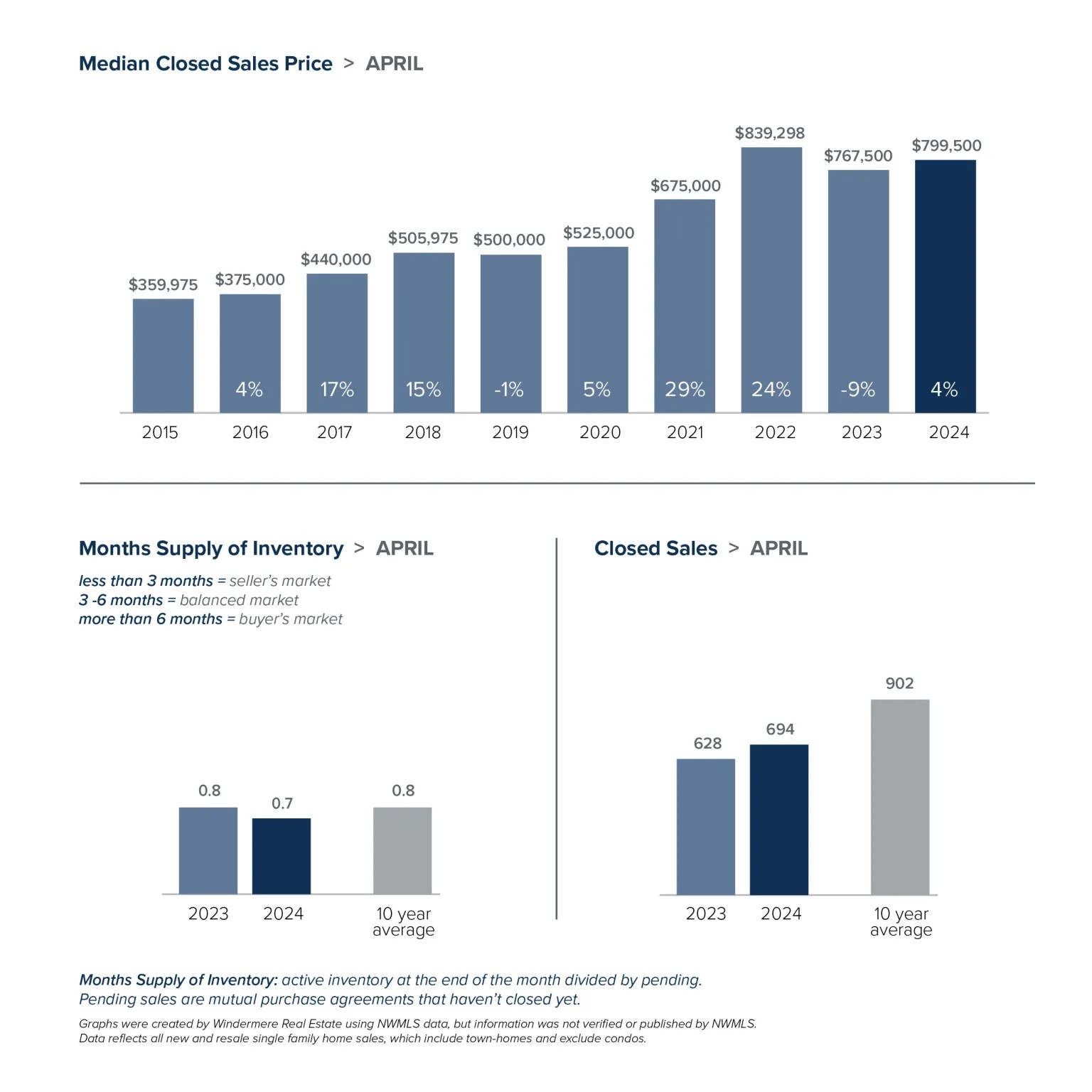
Last month, Snohomish County saw a high rate of closed residential transactions – 76% – that sold at or above asking price. With the number of active residential listings down 10% compared to last year, competition among homebuyers was quite strong. The median sold price of a Snohomish County single-family home rose to $799,500 in April, up 4% from a year prior. Conversely, Snohomish County median condo prices dropped by 4% year over year, to $525,000 last month.

In this market, buyers who find a home they love will need to be ready to compete and willing to stomach rising interest rates. There is some market optimism that the next four to six months will see higher levels of for-sale inventory that will have an impact on stabilizing price levels. In the meantime, prospective home and condo sellers will likely continue to encounter strong interest and offers from buyers, along with fast market times.

Whether you’re waiting on the sidelines for the perfect moment to jump into the market or have taken the plunge and are actively seeking to buy or sell, your Windermere broker will provide valuable insights to help you best navigate the spring and summer market ahead.

EASTSIDE

King County

Seattle

Snohomish County


For Home Owners March 4, 2024

Unique Ways to Increase Your Home’s Energy Efficiency

An energy-efficient home presents many benefits, including lower utility bills, improved indoor comfort, and minimized environmental footprint. The good news is you can achieve all these advantages with just a few inexpensive tweaks in and around your property. Here are eight unique ways to boost energy efficiency in your home.

1. Upgrade Shades and Drapes

Did you know installing cellular drapes can reduce unwanted solar heat gain by up to 60% during winter? They can also minimize heat loss through windows by up to 40% during the warmer months.

These simple measures can significantly impact energy efficiency and increase the thermal comfort in your home. Beyond installing better curtains, keep doors and windows closed to prevent heat or cold from escaping outdoors.

2. Maximize Residual Heat

Your home uses more energy during the cold season since you’ll likely spend more time indoors. Maximizing residual heat from everyday activities can increase efficiency and save you money. For instance, you could slow-cook your meals or open the oven door as it cools down so the heat energy wafts through your home. You can also leave the bathroom open after a steamy shower to let the warm air permeate nearby spaces.

Another option is to install reverse ceiling fans. Reversing the fan blades’ spin direction pushes warm air back down, making the room feel warmer without the additional strain on your home furnace.

3. Tint Your Windows

Applying a thin film to the surface of your windows is an inexpensive way to ramp up your home’s energy efficiency year-round. During summer, tinted windows reflect solar heat away from your home, keeping indoor temperatures cooler. In the winter, tinted windows prevent heat from escaping, keeping internal spaces warmer.

Tinting your windows is relatively easy and only costs around $5-$15 per square foot. Beyond improving energy efficiency, tinted glass surfaces reduce glare and add privacy, enhancing overall comfort.

4. Install a Demand-Type Water Heater

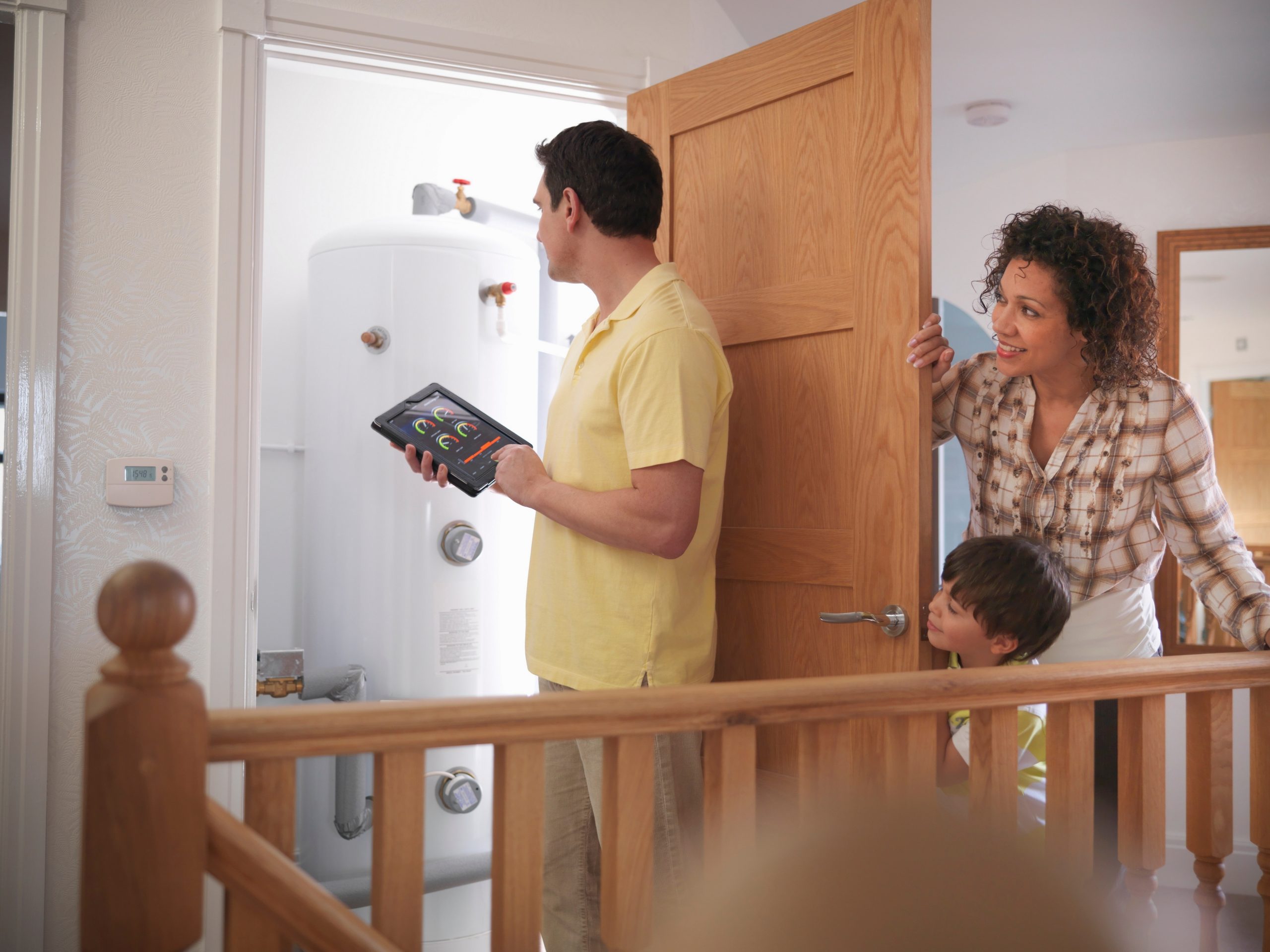
According to the Department of Energy, water heating is the second-largest consumer of energy in your home. Switching to a tankless or instantaneous water heater can minimize energy use and improve efficiency. These tank systems provide hot water only when needed, eliminating the standby energy losses associated with traditional storage heaters.

Moreover, it means you and your family can enjoy a constant hot water supply without waiting for a storage tank to fill up. One drawback to keep in mind is that the initial installation costs of tankless water heaters are much higher than a conventional tank storage system. However, long-term energy savings can offset these expenses.

5. Replace Air Filters

Look at the air filters in your home appliances, particularly in your heating and cooling systems. If they’re dusty or otherwise clogged, consider replacing them or at least have them thoroughly cleaned. Dirty filters make your HVAC equipment work harder to maintain your preferred indoor temperature, which in turn increases the rate of energy consumption.

Regularly changing your air filters will also improve air quality and minimize the risk of fire hazards. That being said, replacing filters often can impact your wallet. It often makes more sense to opt for higher-quality screens that don’t require frequent changing.

6. Switch to a Lighter-Colored Roof

Darker colors are known for their heat-absorbing properties, making indoor spaces considerably hotter. That means more work for your cooling system and, by extension, higher utility bills. On the other hand, lighter-colored roofs reflect heat away from your home, minimizing the energy required to maintain a cool interior.

However, note that changing your roofing system can be costly. Plus, if you don’t get it right the first time, you’ll often have to redo the entire process. That’s why working with roofing experts who offer stellar labor and material warranties is crucial. Remember, roofing is not a DIY job.

7. Eliminate Energy Vampires

No, this doesn’t mean you should break out the stakes and garlic. Energy vampires simply refer to appliances that use power even when not in use. Coffee makers, game consoles, phone chargers and several other constantly plugged-in gadgets in your home could be driving up energy consumption without you knowing.

These phantom plug loads draw relatively little standby power but quickly add up, accounting for up to 20% of your electric bill. This means you could save a lot or money just by unplugging appliances in your home when you’re not using them. Consider moving these devices onto a power strip, allowing you to turn multiple appliances on or off simultaneously.

8. Plant Trees Around Your Home

Strategically positioned trees can save up to 25% of the energy used in a typical household. They provide relief from the sun, lowering the temperature around your home and improving the efficiency of your HVAC system. A row of trees and hedges outside your property can also protect against strong winds and inclement weather.

The obvious drawback here is the time required for your landscaping to fully grow before you can realize the energy-saving benefits. You could opt for rapidly growing trees like poplars and cypresses as a workaround.

Increase Your Home’s Energy Efficiency

Amid rising energy costs and growing concerns about environmental impact, improving your home’s energy efficiency is more crucial than ever. Take advantage of these unique methods to enjoy higher savings on your utility bills and sleep better, knowing you’re doing your part in promoting a sustainable future.


This post was written by Evelyn Long for the Kari Haas Real Estate Team blog.
Evelyn Long is the Editor-in-Chief of Renovated Magazine and a writer with a focus in the real estate sector. Her passion is to make the real estate market easier for young homeowners as they navigate buying, maintaining, and selling homes.


Real Estate Market Updates & Insight February 28, 2024

Local Market Update – February 2024

Like some plants and trees, the local real estate market is starting to bloom. Last month, median residential sold prices increased in each of the four geographic areas covered below. That’s welcome news for intending home sellers, who are also benefitting from continued low inventory region-wide. At the same time, local buyers are seeing stabilizing interest rates (currently in the mid-6-percent range) while confronting hefty competition for available properties. With residential supply shrinking last month, compelling offers continue to be the key to buyers securing a home.

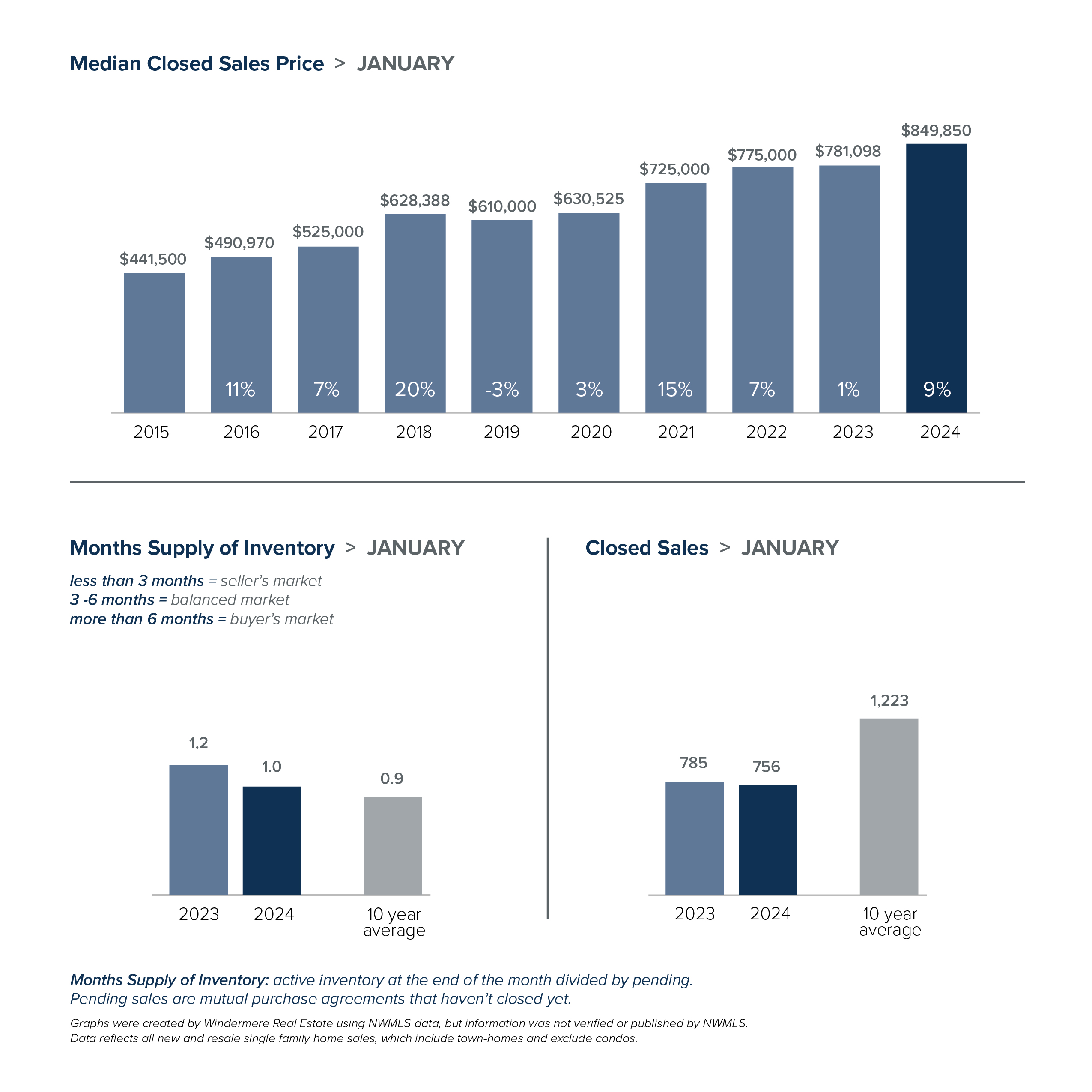
In King County last month, single-family home prices rose by 9% year over year, to $849,850. Condo prices gained momentum as well, rising to $495,000 last month, up 10% from $450,000 a year ago. With limited new listings coming on the market in January, the inventory of available King County single-family homes dropped to 1.0 months of supply, down from 1.3 months at the end of December 2023.

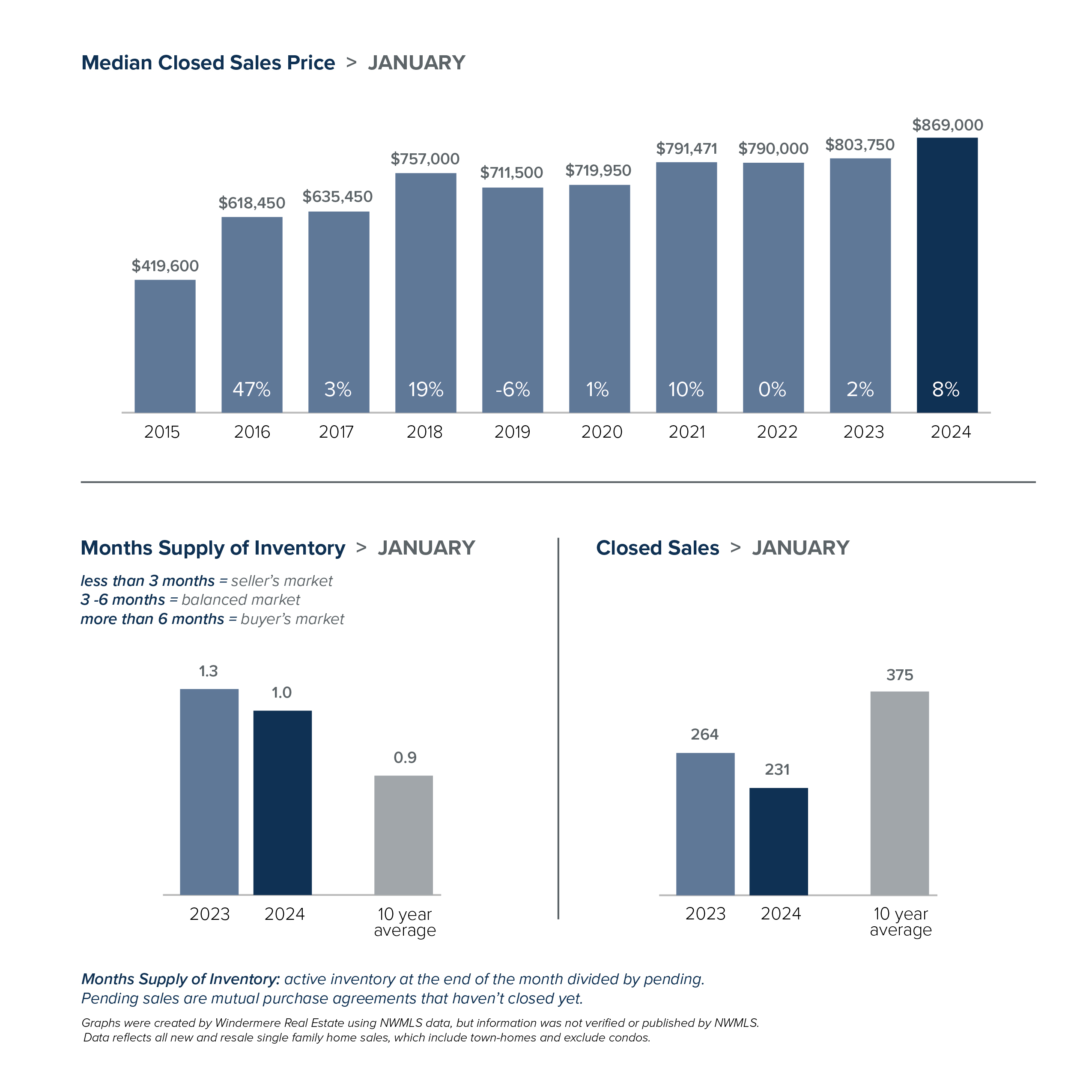
Seattle also saw an increase in home prices last month, with an 8% year-over-year jump to $869,000, up from $803,750 in January 2023. The supply of homes in Seattle dropped from 1.7 months to 1.0 months, spurring buyer competition. Seattle condo prices also rose year over year, from $487,500 in January 2023 to $537,500 last month, while supply dipped to 2.1 months of inventory, having started the year at 2.5 months.

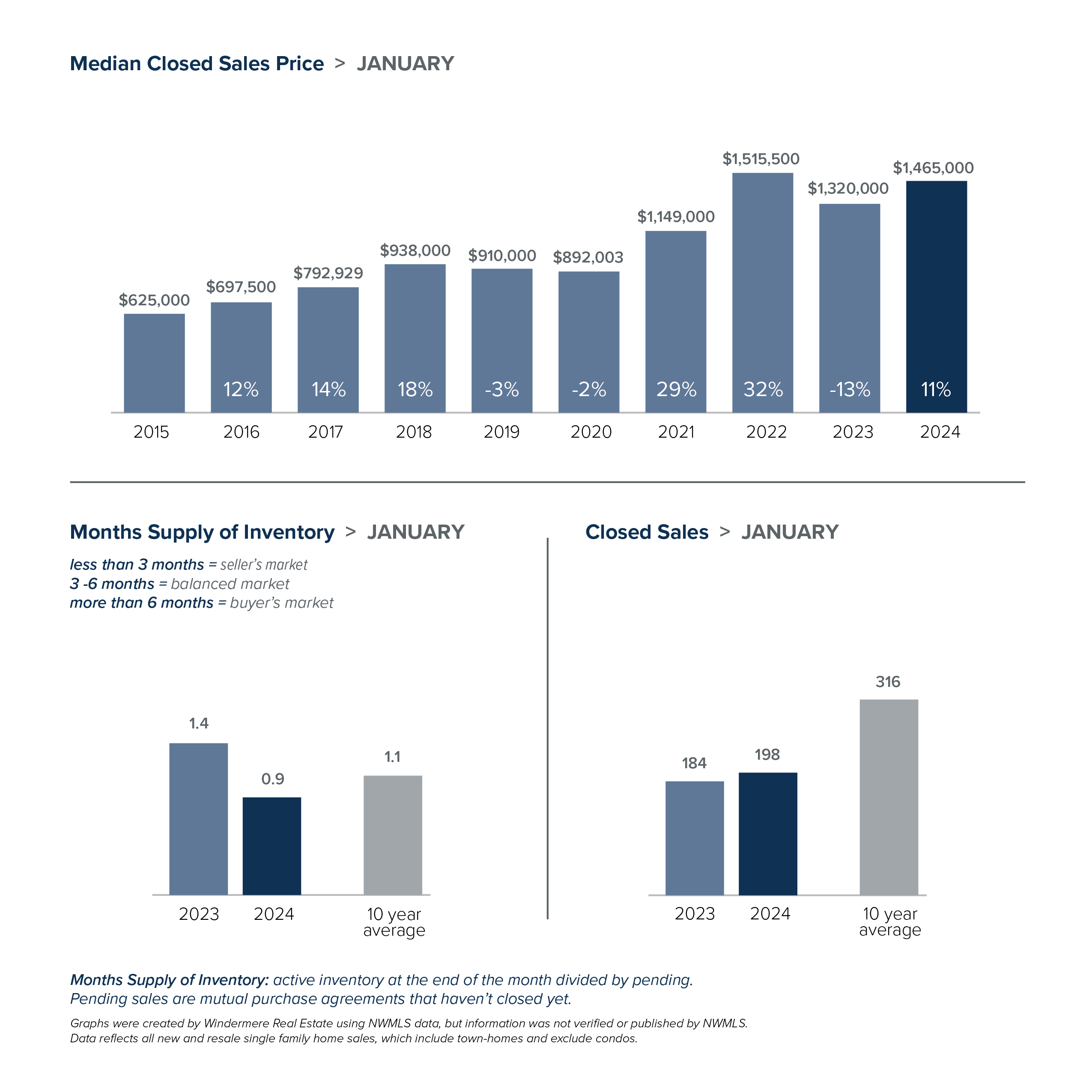
On the Eastside, the median sold price for a single-family home was $1,465,000 in January, up 11% from $1,320,000 the year prior. The supply of Eastside homes dropped from 1.2 months of inventory at the beginning of January to just 0.9 months by February 1, and more than half of the area’s available homes sold in under 30 days. Condo prices also rose last month, though at a slower rate. The median sold price for an Eastside condo increased 5% to $570,000, up from $543,000 in January 2023.

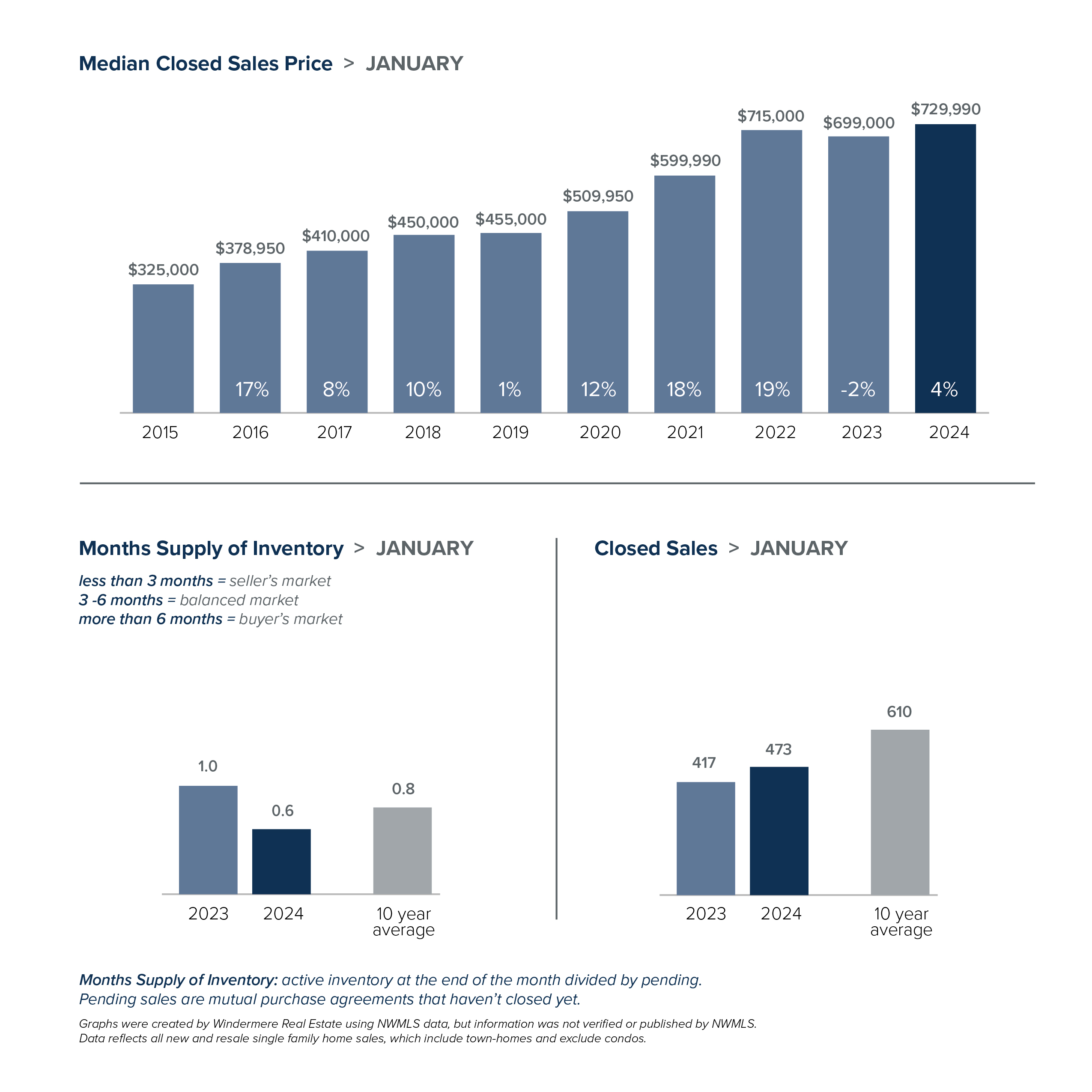
Snohomish County home prices rebounded last month, perhaps feeling the effects of a continued drop in inventory. The median residential sold price increased by 4% year over year, up from $699,000 in January 2023 to $729,990 last month. By the end of January, the supply of Snohomish County single-family homes stood at just 0.6 months of inventory. Perhaps reflecting these supply constraints, the median sold price for a Snohomish County condo jumped by 13% last month compared to January 2023.

While real estate market activity has remained slow in accordance with seasonal buying patterns and low inventory, residential prices have been on the rise. The regional condo market, despite its comparatively greater supply (as measured in months of inventory), has seen its share of recent price gains as well.

In the face of a rapidly evolving market, it’s more important than ever to connect with your Windermere broker. They can provide insight into the changing dynamics of regional submarkets, offer nuanced expertise, and move quickly when the time is right for you to attain your real estate goals.

EASTSIDE

King County

Seattle

Snohomish County

Kari's BlogReal Estate Market Updates & InsightReal Estate Related January 29, 2024

Local Market Update – January 2024

Despite moments of snow in Western Washington, the local real estate market is slowly warming, as new opportunities arise for both home buyers and sellers. Lower mortgage rates are welcome news for buyers, and low inventory means sellers are starting the year with minimal competition.

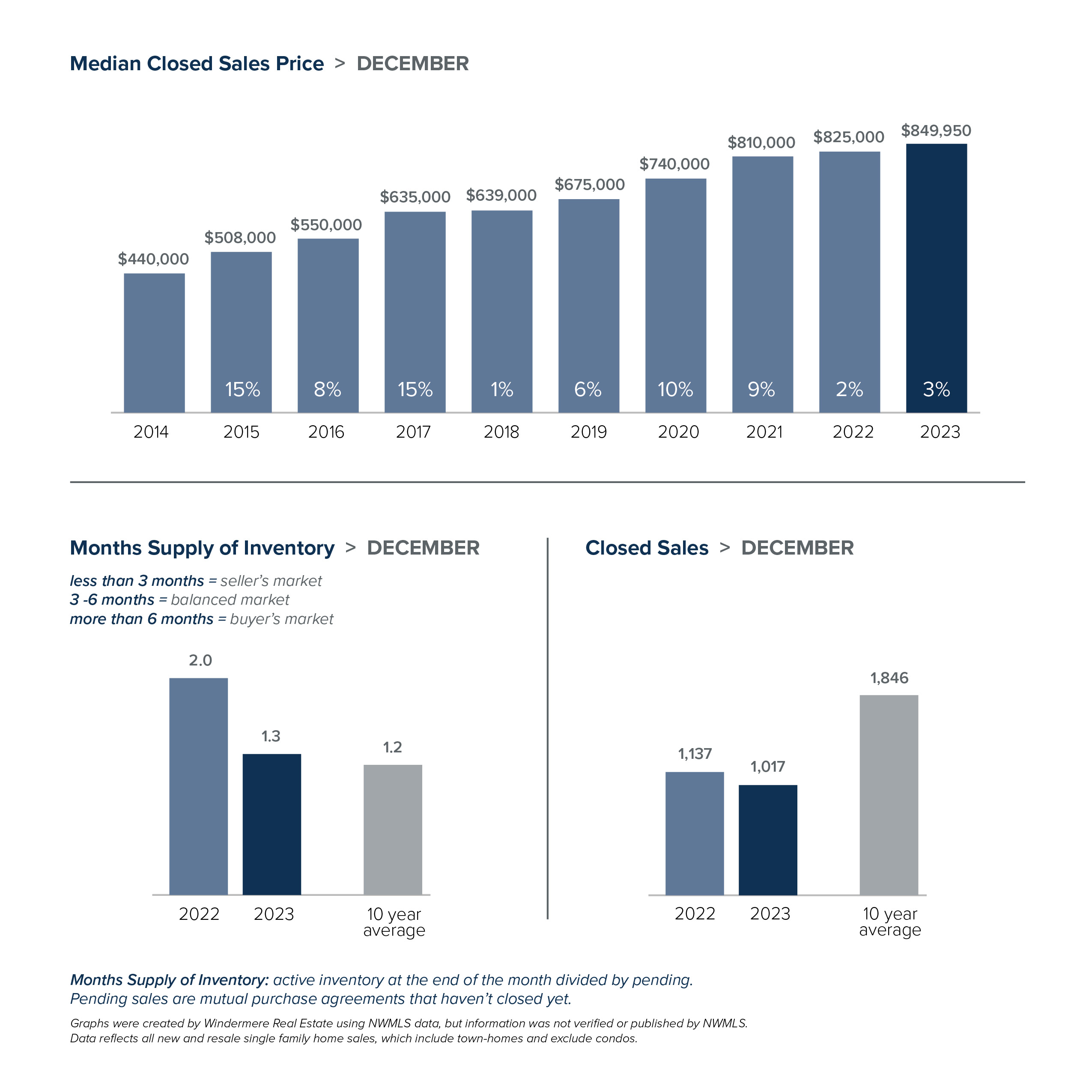
King County continues to see residential price gains, with last month’s median sold price of $849,950 up from $825,000 a year ago. Condo prices also rose, up 15% from $465,000 in December 2022 to $537,000 last month. King County is also experiencing a reduced supply of available single-family homes. At the end of last month, inventory stood at 1.3 months, down from 1.6 months at the end of November and 2.0 months a year prior.

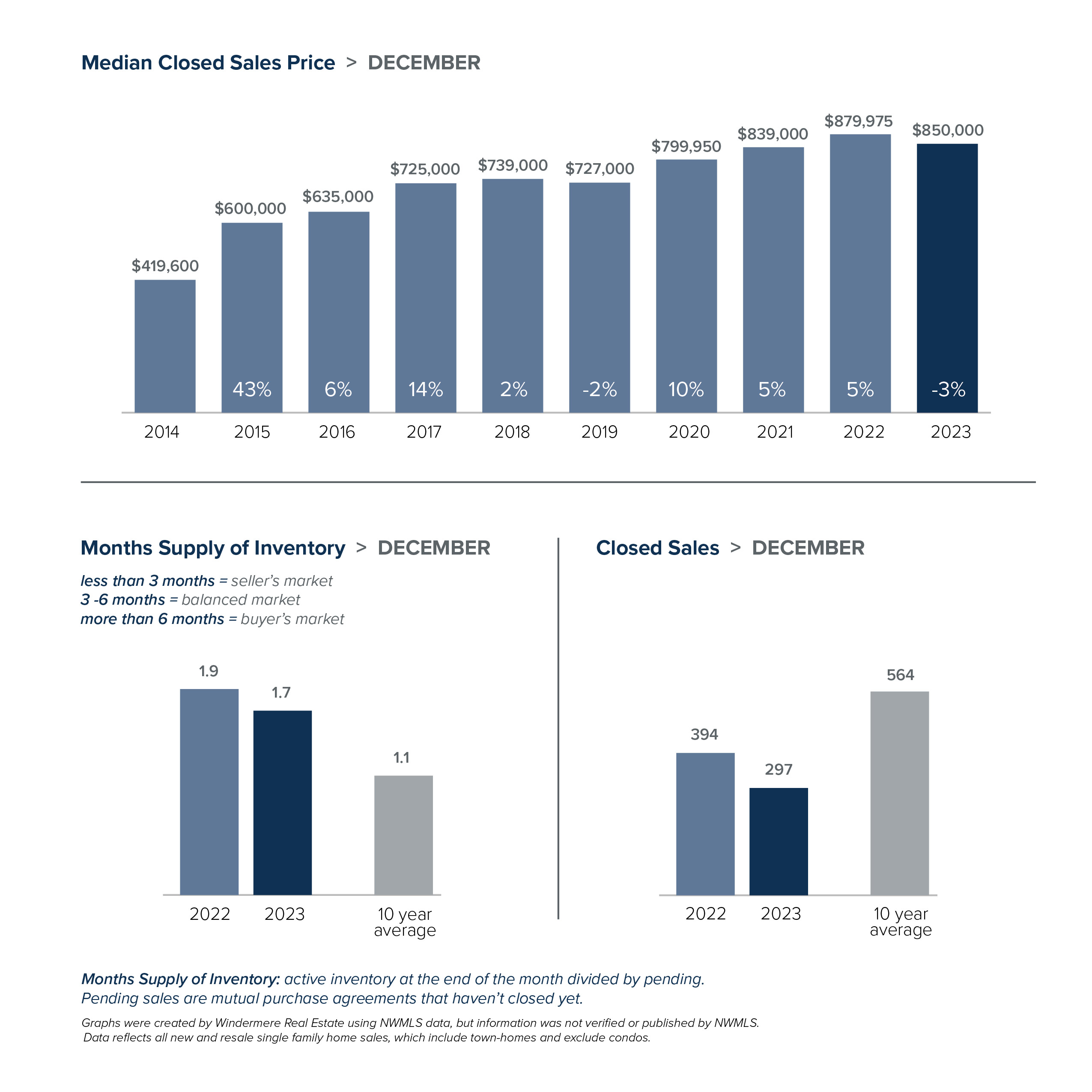
In a slightly different dynamic, Seattle experienced a decrease in both inventory and home prices last month. The median residential sold price was down from $879,975 in December 2022 to $850,000 last month. And December ended with 1.7 months of inventory, down from 1.9 months the previous month. While 16% of homes sold above list price in December, that was significantly lower than November, when 29% sold above asking. Seattle condo prices rose year-over-year, from $512,500 in December 2022 to $585,000 last month, with supply dropping 22 percent.

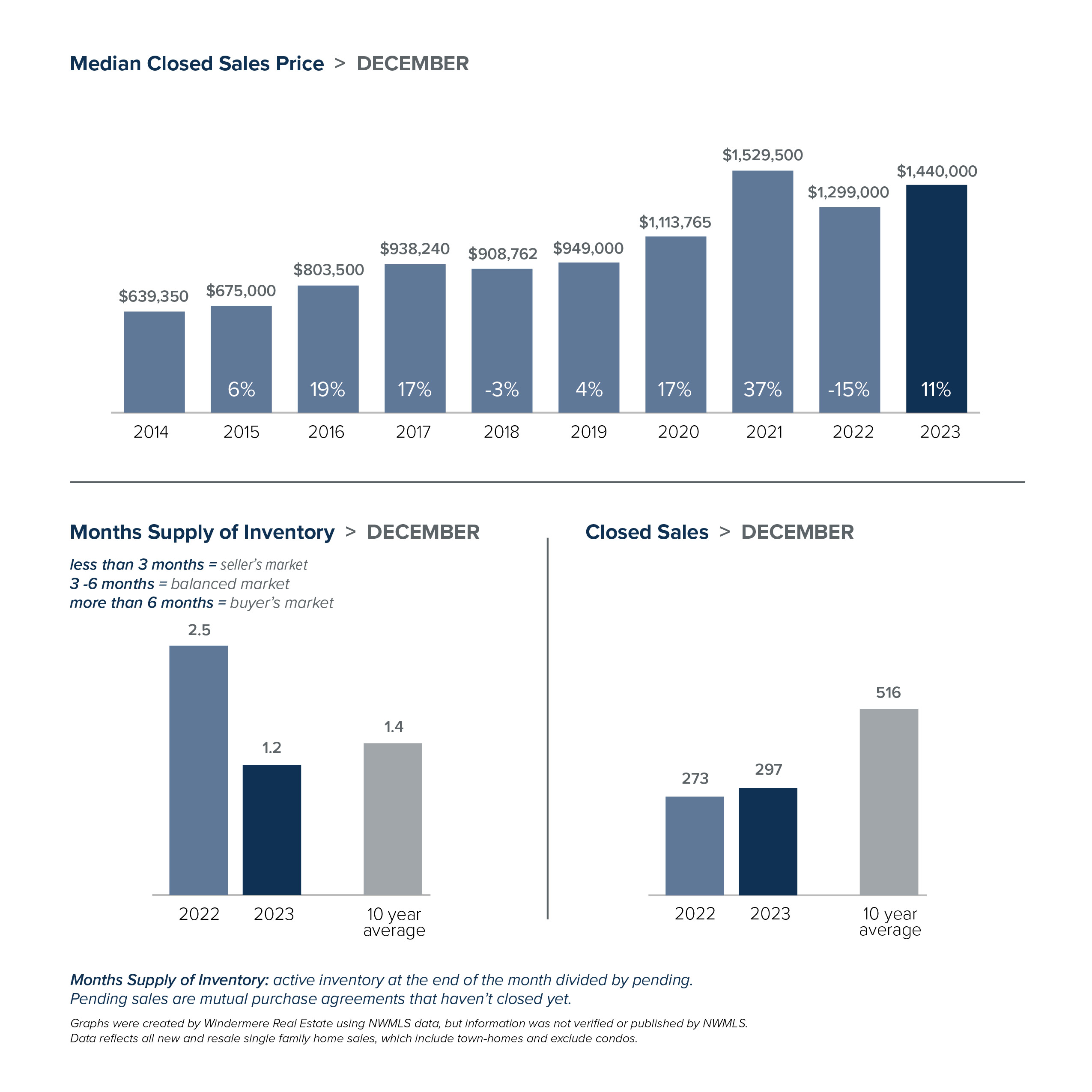
Following a modest decline in November, the Eastside rallied with an 11% bump in the median residential sold price, up from $1,400,000 last year to $1,440,000 last month. Further proof of a warming Eastside market: residential inventory is less than half of what it was last year, down from 2.5 months at the end of 2022 to just 1.2 months at the end of 2023. Mirroring the residential market, Eastside condominiums experienced a healthy 12% price increase last month, up from a median of $565,000 a year ago to $630,000.

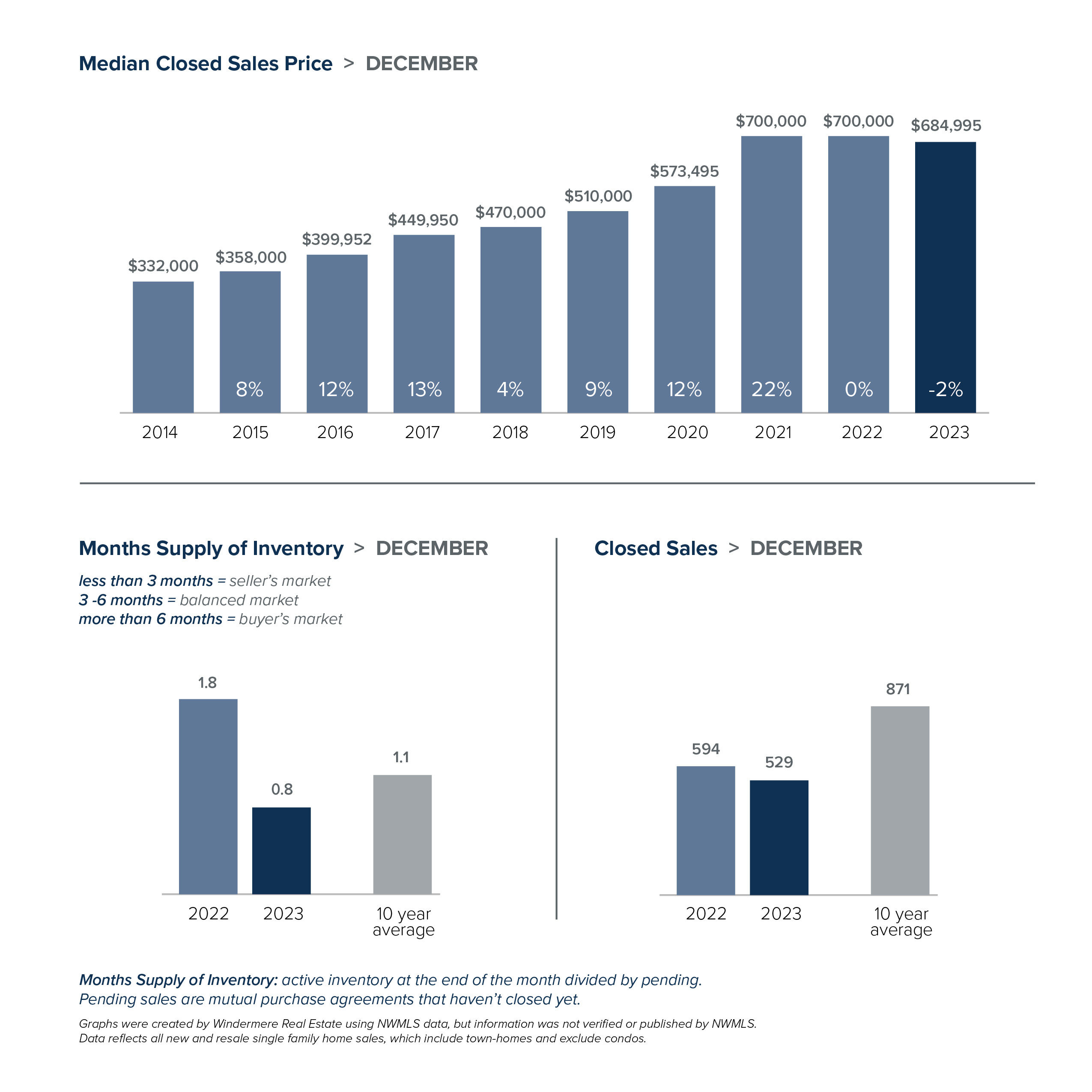
Snohomish County was an interesting tangle of contradicting sales data. Median residential sold prices saw a slight year-over-year decrease last month, down from $700,000 to $684,995. This price decrease occurred despite a dramatic drop in inventory. The supply of Snohomish County single-family homes stood at just 0.8 months at the end of December, down from 1.8 months the year prior. Of the four areas reported in this market update, Snohomish County saw the lowest percentage of sold homes that had experienced a price reduction, at 41%, perhaps a reflection of the drastically reduced supply. Another possible outcome of the limited supply of single-family homes: the median sold price for Snohomish County condos jumped 11% year over year, from $469,950 in December 2022 to $523,500 last month.

As we move further into the new year, buyers remain hopeful that interest rates will continue to drop. The inventory of homes on the market has declined from a year ago in most markets, prompting price gains during what’s normally a slower time of year. Overall, the regional condo market has seen sustained activity, with unit sales experiencing only a modest decrease in the face of lower inventory and higher prices.

With regional submarkets exhibiting varying dynamics, it’s more important than ever for buyers and sellers to have a knowledgeable expert at their side. So connect with your Windermere broker to co-create a strategy that’s best for your buying or selling journey.

EASTSIDE

King County

Seattle

Snohomish County


Kari's BlogReal Estate Market Updates & InsightReal Estate Related December 15, 2023

Local Market Update – December 2023

Just like December temperature variations, our local real estate market continues to feel up and down. Interest rates, regional economic conditions and seasonal market shifts have meant rising home prices in some areas and drops in others. While the expected winter slowdown means overall lower inventory, buyers are still willing to compete for plum properties in a diminishing pool of available listings.

A slight decrease in interest rates has raised cautious optimism in our region. Interest rates fell to around 7.2% as of December 1, compared to 7.8% in October. A continued trend in this direction could signal some welcome positivity in the market as we move into the new year.

In King County, the expected decline in winter inventory is pushing up year-end home prices. The region saw a 7% year-over-year increase in the median residential sold price, from $827,000 in November 2022 to $885,500 last month. Buyers are still showing up: there’s steady demand and potential competition for each available home that’s in good condition and well-priced. King County condos also saw a year-over-year price increase, with the median sold price up 4% in November to $485,000.

Seattle saw a 5% increase in the median sold price of a single-family home, up from October’s $900,000 to $944,000 last month. The market kept some momentum in November, with 48% of Seattle homes selling at or above asking price and 79% going under contract in 30 days or less. Condo prices saw a 21% year-over-year jump, from $480,500 in November 2022 to $582,750 last month. This price growth flew in the face of significant supply, at 3.4 months of inventory.

The Eastside median residential sold price experienced a modest decline in November, down 1% from October’s $1,420,000 to $1,400,000 last month. However, the November price was still up 6% from November 2022, while 75% of sold listings went under contract in 30 days or less. Residential inventory remained fairly flat on the Eastside, increasing slightly from 1.5 months in October to 1.6 months in November. Eastside condo prices increased last month, with a median sold price of $620,000, up from $569,500 in November 2022.

Snohomish County saw a year-over-year bump in prices last month. The median sold price for a single-family home rose from $700,000 last November to $725,000 this November. Supply stood at just 1.3 months at the end of the month, down 32% from this time last year. Condo prices also rose, from $507,500 in November 2022 to $521,209 last month.

As winter unfolds, it’s crucial for buyers and sellers to work with a knowledgeable broker to navigate this churning real estate market. Together you can create a strategy that best supports your real estate goals for the new year.

EASTSIDE

Tips & TricksUpgrades & Renovations December 4, 2023

Unveiling the Secrets of DIY Appliance Fixes

Fixing your appliances yourself offers a dual benefit: It’s both economically advantageous and personally satisfying. Taking on these tasks can significantly extend the lifespan of your household gadgets, reducing the need for costly replacements. However, the importance of being well-informed and cautious cannot be overstated. Approaching your repairs with the right knowledge and care is crucial for success. In this article from the Kari Haas Real Estate Team, we’ll delve into a comprehensive seven-step guide to ensure your DIY appliance repairs are efficient, safe, and cost-effective.

Taking Safety Measures

Before attempting any repair, it’s crucial to disconnect the appliance from its power source or shut off the circuit breaker. This step is essential in preventing the risk of electrical shock or other potential hazards. Your safety is the top priority when tackling DIY repairs. Failing to take proper precautions can lead to serious injuries, so never neglect this vital step.

Diagnosing the Issue

Don’t start unscrewing parts until you’ve properly identified the problem. Check your appliance’s user guide or seek advice from credible online resources to understand the nature of the malfunction. Correctly pinpointing the issue will help you determine if it’s something you can handle, or if professional intervention is needed.

Tapping into the Internet

The internet is a treasure trove of wisdom for DIY repairs. Websites specializing in appliance fixes, instructional YouTube videos, and online forums can offer expert advice and helpful walkthroughs. These platforms are often frequented by seasoned DIYers who share their knowledge and tips for successful fixes.

Ensuring You’re Using Quality Tools

Having the right tools is crucial for any DIY repair. At the very least, ensure you have a quality set of screwdrivers, adjustable wrenches, a multimeter, and a socket set. These basic tools are versatile enough to handle many common repair jobs. Investing in good-quality tools will not only make the repair process easier but also more efficient.

Finding Specialized Components

When your DIY appliance fix calls for new parts, choose a supplier who stocks a wide range of quality components. For example, you may need a specialized item like a peripheral driver, which ensures seamless functionality by enabling the communication and control between the main processing unit and external devices. Find a supplier who has real-time inventory from dependable manufacturers around the world. This will not only save you time but also ensures that you are getting parts that will last.

Staying Organized and Documenting Steps

Patience and organization can be the determining factors between a successful repair and a botched job. As you dismantle your appliance, document each step either by taking pictures or jotting down notes. This will greatly assist you when it’s time to put everything back together and can prevent the unfortunate occurrence of “leftover” parts.

Knowing When to Call a Professional

A thorough assessment of how complicated the issue is can save you a lot of time and potential frustration. While some fixes are generally safe for you to take on yourself, more intricate repairs may necessitate the assistance of a certified technician. Reaching out to a professional may be necessary if you lack the necessary expertise to avoid causing further damage to the appliance.


Being your own appliance repair technician can be a fulfilling and money-saving experience. Adhering to these key principles of ensuring safety, evaluating repair complexity, correctly identifying issues, gathering the appropriate tools, making use of available online resources, selecting high-quality components, and maintaining an organized approach will greatly enhance your DIY repair capabilities. By implementing these vital strategies, you are setting yourself up for success in your DIY appliance fixes.

Discover the exceptional service and expertise of the Kari Haas Real Estate Team. Let us help you sell your house and find your home.

Tips & Tricks October 24, 2023

Home safety for trick or treaters

Everyone wants an accident-free Halloween in the neighborhood, so these few tips will ensure the local kids have a scary and super-fun night.

Clear Paths
Before the little ghouls and goblins start their quest for treats, take a stroll around your front yard. Remove any lurking garden tools or toys that might pose a tripping hazard. A clear path sets the stage for a safe and enjoyable Halloween adventure.

Light It Up
Illuminate the night by turning on your exterior lights, especially if you have outlined your garden path with spooky lighting. Well-lit pathways not only enhance the Halloween atmosphere but also contribute to the safety of the trick-or-treaters navigating through the neighborhood.

Flame-Free Decor
While crafting your haunted house masterpiece, consider using flame-free decorations. Opt for LED lights, paper lanterns, or other non-flammable materials to create a chilling ambiance without the risk of fire hazards.

Cable Danger
If your Halloween setup requires electricity, be mindful of extension cords and cables. Ensure that they are safely tucked away from the paths where trick-or-treaters will be wandering. No one wants a spooky surprise of tripping over cords in the dark.

Sweet Treats with a Twist
Join the “treat brigade” by offering candy in reflective bags or opting for reflective gifts. This small touch not only adds a festive flair but also enhances the visibility of the little ones as they move through the neighborhood. Safety can be stylish, too!

Allergies Matter
In the spirit of inclusivity, be mindful of allergies when assembling your stash of treats. Avoid including nuts or chocolates with nut content to ensure that all trick-or-treaters can enjoy their Halloween goodies without any concerns.

Check the Candy Stash
Before the doorbell starts chiming, take a moment to inspect your candy stash. Discard any treats with slightly opened wrappers, and ensure that everything is safe and edible. A little precaution goes a long way in providing a worry-free Halloween experience.

Be Blunt with Props
Transforming your home into a haunted haven often involves props like swords and wands. Prioritize safety by ensuring that these items are soft and pose no harm to curious trick-or-treaters. A spooky atmosphere should be thrilling, not dangerous.

Brief the Neighbors
Whether you’re planning an epic Halloween bash or prefer a quieter night, a friendly heads-up to the neighbors is always a good idea. Share your plans for the night, so everyone is on the same page and can enjoy Halloween in their preferred way.

This Halloween, let’s make a commitment to create a safe and spooktacular environment for trick-or-treaters. By implementing these tips, homeowners can contribute to a community where Halloween is not only frightful but also full of fun and laughter. Together, let’s ensure that every ghost, witch, and superhero can enjoy a memorable and safe Halloween night!